Sex remains one of the most salient demographic dividing points in American politics today. President Obama has women, particularly unmarried women, to thank for his re-election victory. The gender difference in voter support for the Democratic and Republican presidential candidates grew from twelve points in 2008 to eighteen points in 2012. This gender gap in candidate preference likely emerges because of gender gaps in policy preferences. Yet despite much scholarly and popular interest in this topic, the cause or causes of gender gaps in policy preference remain unclear. The Political Battle of the Sexes: Exploring the Sources of Gender Gaps in Policy Preferences examines gender gaps in policy preferences in the United States, outlines their form, and explores their causes.
This work makes four contributions to the literature on gender gaps. First, it provides the first comprehensive look at gender gaps across time and various issue areas completed since the 1980s. Second, it provides a theoretical framework for explaining the causes of gender gap emergence that incorporates both nature (biology) and nurture (socialization) and provides the basis with which to predict the attitudes on which gender gaps will likely emerge. Third, it explores the causes of gender gaps in foreign and social policy, two of the policy domains where gender gaps continue to increase. Finally, it introduces a new way of conceptualizing biology based on emerging research in the hard sciences.
Studying gender gaps remains difficult. Women comprise a very diverse group, and are divided by far more factors than the sex categorization that unites them. However, electoral realities demand that scholars studying political behavior pay attention to sex based differences in political preferences. Women exhibit consistent preference tendencies relative to men, and women remain more likely to show up on Election Day than men. As such, gender gaps have substantial political and practical implications for women in the United States. And while explaining their causes requires drawing from a wide array of fields, ranging from biology to economics, understanding the origins and consequences of gender gaps does much to further empirical research in public opinion and mass behavior.
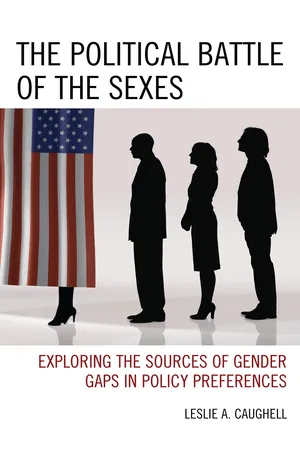
eBook - PDF
The Political Battle of the Sexes
Exploring the Sources of Gender Gaps in Policy Preferences
- 169 pages
- English
- PDF
- Available on iOS & Android
eBook - PDF
The Political Battle of the Sexes
Exploring the Sources of Gender Gaps in Policy Preferences
About this book
Information
Table of contents
- Contents
- Acknowledgments
- Chapter One. The Gender Divide in American Politics
- Chapter Two. Theorizing Gender Gaps
- Chapter Three. Gender Gaps in American Public Opinion, 1948–2008
- Chapter Four. Women at War
- Chapter Five. Women and Domestic Policy Preferences
- Chapter Six. Gender Gaps Moving Forward
- Appendix A: Gender Gaps over Time
- Appendix B: Methodology
- Appendix C: Foreign Policy Figures
- Appendix D: Social Policy Figures
- References
- Index
- About the Author
Trusted by 375,005 students
Access to over 1.5 million titles for a fair monthly price.
Study more efficiently using our study tools.
Frequently asked questions
Yes, you can cancel anytime from the Subscription tab in your account settings on the Perlego website. Your subscription will stay active until the end of your current billing period. Learn how to cancel your subscription
No, books cannot be downloaded as external files, such as PDFs, for use outside of Perlego. However, you can download books within the Perlego app for offline reading on mobile or tablet. Learn how to download books offline
Perlego offers two plans: Essential and Complete
- Essential is ideal for learners and professionals who enjoy exploring a wide range of subjects. Access the Essential Library with 800,000+ trusted titles and best-sellers across business, personal growth, and the humanities. Includes unlimited reading time and Standard Read Aloud voice.
- Complete: Perfect for advanced learners and researchers needing full, unrestricted access. Unlock 1.5M+ books across hundreds of subjects, including academic and specialized titles. The Complete Plan also includes advanced features like Premium Read Aloud and Research Assistant.
We are an online textbook subscription service, where you can get access to an entire online library for less than the price of a single book per month. With over 1.5 million books across 990+ topics, we’ve got you covered! Learn about our mission
Look out for the read-aloud symbol on your next book to see if you can listen to it. The read-aloud tool reads text aloud for you, highlighting the text as it is being read. You can pause it, speed it up and slow it down. Learn more about Read Aloud
Yes! You can use the Perlego app on both iOS and Android devices to read anytime, anywhere — even offline. Perfect for commutes or when you’re on the go.
Please note we cannot support devices running on iOS 13 and Android 7 or earlier. Learn more about using the app
Please note we cannot support devices running on iOS 13 and Android 7 or earlier. Learn more about using the app
Yes, you can access The Political Battle of the Sexes by Leslie A. Caughell in PDF and/or ePUB format, as well as other popular books in Politics & International Relations & American Government. We have over 1.5 million books available in our catalogue for you to explore.