This study examines the role of the Six-Day War in American Protestant politics and culture. The author argues that American foreign policy towards the Arab-Israeli conflict, culminating in the Trump Administration's 2017 recognition of Jerusalem as Israel's capital, and the domestic Evangelical communities who supported it, has a direct correlation with the long-term consequences of the 1967 Six-Day War.
For most of America's history, biblical literalists, or Evangelicals, dominated the religious culture of the country. But, in 1925, the Scopes trial on science, evolution, and religion embarrassed Evangelicals and caused them to retreat from American culture and politics. Modern and liberal Protestants won dominance and established control in nearly all of the Mainline seminaries, publishing houses, and denominations, leading to the creation of the National Council of Churches by 1950.
This book argues that the Six-Day War reversed that power structure in American religion, with Evangelicals returning to a place of prominence in American culture and politics. Whereas the Scopes trial showed much of American Protestantism that the Modernists had the right understanding of the Bible; the Six-Day War demonstrated that, ironically, Evangelicals may have had it right all along. They used this historic leverage to vaunt themselves into the highest planes of American life, with Billy Graham becoming "America's Pastor."
In this historic process, the 1967 war between Israel and the surrounding Arab states clarified the way those different branches of American Protestantism thought about the Arab-Israeli conflict, particularly the issue of Jerusalem. Indeed, the nature of the Six-Day War was deep and appeared to be of Biblical proportions.
Because Israel gained territories in Jerusalem, Bethlehem, and the ancient Biblical heartlands formerly held by Jordan; historical, messianic, and even apocalyptic intrusions entered the various branches of American Protestantism. In some branches, supersessionism, a belief that the Church had replaced the Jewish people as God's chosen, was stoked. In other branches, supersessionism was rejected and the nature of Judaism and its connection to the Holy Land was re-evaluated. The important point is that the territories that Israel captured had thick theological meaning, and this would force all branches of American Protestantism to reconsider their assumptions about Judaism and Zionism, as well as Islam and Palestinian nationalism.
Evangelicalism.
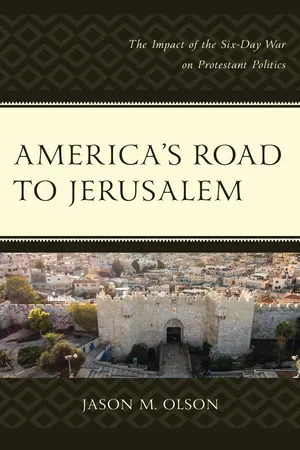
eBook - PDF
America's Road to Jerusalem
The Impact of the Six-Day War on Protestant Politics
- 281 pages
- English
- PDF
- Available on iOS & Android
eBook - PDF
About this book
Information
Table of contents
- Cover
- America’s Road to Jerusalem
- America’s Road to Jerusalem: The Impact of the Six-Day War on Protestant Politics
- Contents
- Preface
- Acknowledgments
- Introduction
- The Major Variables in Protestant Theology
- Chapter 1
- American Protestantism and American Jewry before the Six-Day War
- Chapter 2
- American Protestantism and the State of Israel before the Six-Day War
- Chapter 3
- In the Midst of the Six-Day War
- Chapter 4
- American Protestantism and Israel in the Aftermath of the Six-Day War
- Chapter 5
- From Refugees to Freedom Fighters
- Bibliography
- Index
- About the Author
Trusted by 375,005 students
Access to over 1.5 million titles for a fair monthly price.
Study more efficiently using our study tools.
Frequently asked questions
Yes, you can cancel anytime from the Subscription tab in your account settings on the Perlego website. Your subscription will stay active until the end of your current billing period. Learn how to cancel your subscription
No, books cannot be downloaded as external files, such as PDFs, for use outside of Perlego. However, you can download books within the Perlego app for offline reading on mobile or tablet. Learn how to download books offline
Perlego offers two plans: Essential and Complete
- Essential is ideal for learners and professionals who enjoy exploring a wide range of subjects. Access the Essential Library with 800,000+ trusted titles and best-sellers across business, personal growth, and the humanities. Includes unlimited reading time and Standard Read Aloud voice.
- Complete: Perfect for advanced learners and researchers needing full, unrestricted access. Unlock 1.5M+ books across hundreds of subjects, including academic and specialized titles. The Complete Plan also includes advanced features like Premium Read Aloud and Research Assistant.
We are an online textbook subscription service, where you can get access to an entire online library for less than the price of a single book per month. With over 1.5 million books across 990+ topics, we’ve got you covered! Learn about our mission
Look out for the read-aloud symbol on your next book to see if you can listen to it. The read-aloud tool reads text aloud for you, highlighting the text as it is being read. You can pause it, speed it up and slow it down. Learn more about Read Aloud
Yes! You can use the Perlego app on both iOS and Android devices to read anytime, anywhere — even offline. Perfect for commutes or when you’re on the go.
Please note we cannot support devices running on iOS 13 and Android 7 or earlier. Learn more about using the app
Please note we cannot support devices running on iOS 13 and Android 7 or earlier. Learn more about using the app
Yes, you can access America's Road to Jerusalem by Jason M. Olson in PDF and/or ePUB format, as well as other popular books in History & Middle Eastern History. We have over 1.5 million books available in our catalogue for you to explore.