eBook - PDF
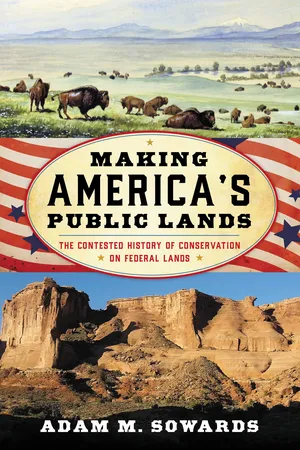
Making America's Public Lands
The Contested History of Conservation on Federal Lands
- 257 pages
- English
- PDF
- Available on iOS & Android
eBook - PDF
About this book
In the United States, the federal government owns more than a quarter of the nation's landscape—nearly 640 million acres; or more than a million square miles, which, if consolidated, would make it the tenth largest nation on earth. Primarily managed by four federal agencies—the Bureau of Land Management, the U.S. Forest Service, the U.S. Fish and Wildlife Service, and the National Park Service--American public lands have been central to developing the American economy, state, and identity. The history of these lands intersects with critical components of the American past—namely nature, politics, and economics. From the beginning, the concept of "public" has been the subject of controversy, from visions of homesteaders realizing the ideal of the Jeffersonian republic to western ranchers who use the open range to promote a free enterprise system, to wilderness activists who see these lands as wild places, free from human encumbrance. Environmental historian Adam Sowards synthesizes public lands history from the beginning of the republic to recent controversies. Since public lands are located everywhere, including iconic national parks like Yellowstone or the Grand Canyon, Americans at large have a stake in these lands. They are, after all, ours. In a real sense, this book is for those citizens who camp in the national forests, drive through the national parks, or admire distant wilderness landscapes. These readers will gain a greater appreciation for the long and complex history of the range of these places.
Information
Table of contents
- Contents
- Acknowledgments
- Introduction
- 1. Gathering
- 2. Forming
- 3. Managing
- 4. Balancing
- 5. Polarizing
- Conclusion
- A Note on Sources
- Index
Trusted by 375,005 students
Access to over 1.5 million titles for a fair monthly price.
Study more efficiently using our study tools.
Frequently asked questions
Yes, you can cancel anytime from the Subscription tab in your account settings on the Perlego website. Your subscription will stay active until the end of your current billing period. Learn how to cancel your subscription
No, books cannot be downloaded as external files, such as PDFs, for use outside of Perlego. However, you can download books within the Perlego app for offline reading on mobile or tablet. Learn how to download books offline
Perlego offers two plans: Essential and Complete
- Essential is ideal for learners and professionals who enjoy exploring a wide range of subjects. Access the Essential Library with 800,000+ trusted titles and best-sellers across business, personal growth, and the humanities. Includes unlimited reading time and Standard Read Aloud voice.
- Complete: Perfect for advanced learners and researchers needing full, unrestricted access. Unlock 1.5M+ books across hundreds of subjects, including academic and specialized titles. The Complete Plan also includes advanced features like Premium Read Aloud and Research Assistant.
We are an online textbook subscription service, where you can get access to an entire online library for less than the price of a single book per month. With over 1.5 million books across 990+ topics, we’ve got you covered! Learn about our mission
Look out for the read-aloud symbol on your next book to see if you can listen to it. The read-aloud tool reads text aloud for you, highlighting the text as it is being read. You can pause it, speed it up and slow it down. Learn more about Read Aloud
Yes! You can use the Perlego app on both iOS and Android devices to read anytime, anywhere — even offline. Perfect for commutes or when you’re on the go.
Please note we cannot support devices running on iOS 13 and Android 7 or earlier. Learn more about using the app
Please note we cannot support devices running on iOS 13 and Android 7 or earlier. Learn more about using the app
Yes, you can access Making America's Public Lands by Adam M. Sowards in PDF and/or ePUB format, as well as other popular books in History & North American History. We have over 1.5 million books available in our catalogue for you to explore.