The Digital Archives Handbook provides archivists a roadmap to create and care for digital archives. Written by archival experts and practitioners, Purcell brings together theoretical and practical approaches to creating, managing, and preserving digital archives. The first section is focused on processes and practices, including chapters on acquisitions, appraisal, arrangement, description, delivery, preservation, forensics, curation, and intellectual property. The second section is focused on digital collections and specific environments where archivists are managing digital collections. These chapters review digital collections in categories including performing arts, oral history, architectural and design records, congressional collections, and email.
The book discuss the core components of digital archives—the technological infrastructure that provides storage, access, and long-term preservation; the people or organizations that create or donate digital material to archives programs, as well as the researchers use them; and the digital collections themselves, full of significant research content in a variety of formats with a multitude of research possibilities. The chapters emphasize that the people and the collections that make up digital archives are just as important as the technology.
Also highlighted are the importance of donors and creators of digital archives. Building digital archives parallels the cycle of donor work—planning, cultivation, and stewardship. During each stage, archivists work with donors to ensure that the digital collections will be arranged, described, preserved, and made accessible for years to come.
Archivists must take proactive and informed actions to build valuable digital collections. Knowing where digital materials come from, how those materials were created, what materials are important, what formats or topical areas are included, and how to serve those collections to researchers in the long term is central to archival work. This handbook is designed to generate new discussions about how archivists of the twenty-first century can overcome current challenges and chart paths that anticipate, rather than merely react to, future donations of digital archives.
eBook - PDF
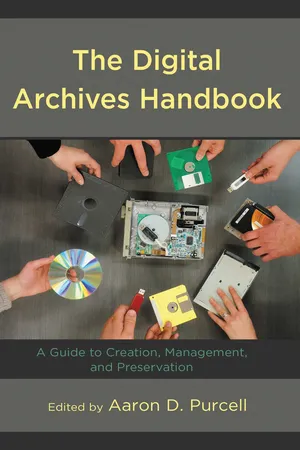
The Digital Archives Handbook
A Guide to Creation, Management, and Preservation
- 272 pages
- English
- PDF
- Available on iOS & Android
eBook - PDF
About this book
Information
Table of contents
- Contents
- List of Figures and Tables
- Preface
- Acknowledgments
- Introduction
- I: Processes and Practices
- II: Collections and Environments
- Index
- Contributors
Trusted by 375,005 students
Access to over 1.5 million titles for a fair monthly price.
Study more efficiently using our study tools.
Frequently asked questions
Yes, you can cancel anytime from the Subscription tab in your account settings on the Perlego website. Your subscription will stay active until the end of your current billing period. Learn how to cancel your subscription
No, books cannot be downloaded as external files, such as PDFs, for use outside of Perlego. However, you can download books within the Perlego app for offline reading on mobile or tablet. Learn how to download books offline
Perlego offers two plans: Essential and Complete
- Essential is ideal for learners and professionals who enjoy exploring a wide range of subjects. Access the Essential Library with 800,000+ trusted titles and best-sellers across business, personal growth, and the humanities. Includes unlimited reading time and Standard Read Aloud voice.
- Complete: Perfect for advanced learners and researchers needing full, unrestricted access. Unlock 1.5M+ books across hundreds of subjects, including academic and specialized titles. The Complete Plan also includes advanced features like Premium Read Aloud and Research Assistant.
We are an online textbook subscription service, where you can get access to an entire online library for less than the price of a single book per month. With over 1.5 million books across 990+ topics, we’ve got you covered! Learn about our mission
Look out for the read-aloud symbol on your next book to see if you can listen to it. The read-aloud tool reads text aloud for you, highlighting the text as it is being read. You can pause it, speed it up and slow it down. Learn more about Read Aloud
Yes! You can use the Perlego app on both iOS and Android devices to read anytime, anywhere — even offline. Perfect for commutes or when you’re on the go.
Please note we cannot support devices running on iOS 13 and Android 7 or earlier. Learn more about using the app
Please note we cannot support devices running on iOS 13 and Android 7 or earlier. Learn more about using the app
Yes, you can access The Digital Archives Handbook by Aaron D. Purcell in PDF and/or ePUB format, as well as other popular books in Languages & Linguistics & Library & Information Science. We have over 1.5 million books available in our catalogue for you to explore.