Much of the current debate about education too often resembles the blind men describing an elephant--apprehending only a particular part of the situation or the process, many analysts tell an evocative but incomplete story. The so-called 'reform' discussion proceeds with a lack of depth about the nuances and realistic limitations in the institutional order of school.
This book argues that as regulation of schools moves further up the bureaucratic hierarchy (first to state departments of education then to the national department of education) the legal and institutional requirements get more intensive but less concretely useful in class rooms. This bureaucratization serves to 'tighten' the organizational environment, thereby increasing the risk of normal accidents. The increasing governmental management, in other words, makes it more likely that schools will 'fail' to meet their goals.
Analyses of education are too often developed for public consumption in a fast-moving political world. This book examines some of the deeper organizational reasons why things don't work so well in school, as well as a look at some of things that do work. Most importantly, the book will explain how the social and cultural expectations of what schools can do may create unrealistic hopes. We, as a society, and schools, as institutions, embrace these unreasonably high hopes at our collective peril.
Check out Andrew's latest interview with Seattle Radio- http://kiroradio.com/listen/9972862/
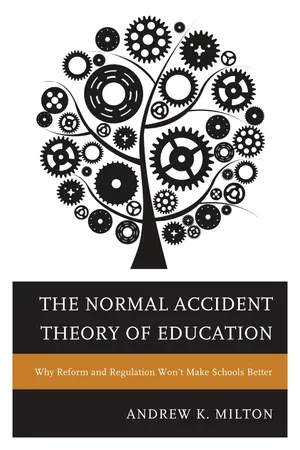
eBook - PDF
The Normal Accident Theory of Education
Why Reform and Regulation Won’t Make Schools Better
- 148 pages
- English
- PDF
- Available on iOS & Android
eBook - PDF
The Normal Accident Theory of Education
Why Reform and Regulation Won’t Make Schools Better
About this book
Information
Topic
EducationSubtopic
Educational PolicyTable of contents
- Contents
- Acknowledgments
- Preface
- 1 The Problem with Public Schools
- 2 Why Schools Have Normal Accidents Routinely
- 3 Complexity and the Social Conversation
- 4 Organizational Culture and Social Expectations
- 5 Standardized Testing Creates a Culture of Complexity
- 6 Standardized Tests and the Complexity of Learning
- 7 Technology Adds Layer of Complication
- 8 Markets and Education
- 9 Where We Go From Here
- Bibliography
Trusted by 375,005 students
Access to over 1.5 million titles for a fair monthly price.
Study more efficiently using our study tools.
Frequently asked questions
Yes, you can cancel anytime from the Subscription tab in your account settings on the Perlego website. Your subscription will stay active until the end of your current billing period. Learn how to cancel your subscription
No, books cannot be downloaded as external files, such as PDFs, for use outside of Perlego. However, you can download books within the Perlego app for offline reading on mobile or tablet. Learn how to download books offline
Perlego offers two plans: Essential and Complete
- Essential is ideal for learners and professionals who enjoy exploring a wide range of subjects. Access the Essential Library with 800,000+ trusted titles and best-sellers across business, personal growth, and the humanities. Includes unlimited reading time and Standard Read Aloud voice.
- Complete: Perfect for advanced learners and researchers needing full, unrestricted access. Unlock 1.5M+ books across hundreds of subjects, including academic and specialized titles. The Complete Plan also includes advanced features like Premium Read Aloud and Research Assistant.
We are an online textbook subscription service, where you can get access to an entire online library for less than the price of a single book per month. With over 1.5 million books across 990+ topics, we’ve got you covered! Learn about our mission
Look out for the read-aloud symbol on your next book to see if you can listen to it. The read-aloud tool reads text aloud for you, highlighting the text as it is being read. You can pause it, speed it up and slow it down. Learn more about Read Aloud
Yes! You can use the Perlego app on both iOS and Android devices to read anytime, anywhere — even offline. Perfect for commutes or when you’re on the go.
Please note we cannot support devices running on iOS 13 and Android 7 or earlier. Learn more about using the app
Please note we cannot support devices running on iOS 13 and Android 7 or earlier. Learn more about using the app
Yes, you can access The Normal Accident Theory of Education by Andrew K. Milton in PDF and/or ePUB format, as well as other popular books in Education & Educational Policy. We have over 1.5 million books available in our catalogue for you to explore.