eBook - PDF
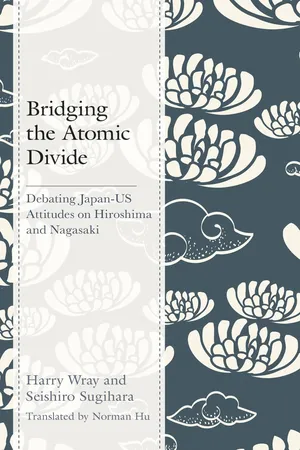
Bridging the Atomic Divide
Debating Japan-US Attitudes on Hiroshima and Nagasaki
- 341 pages
- English
- PDF
- Available on iOS & Android
eBook - PDF
Bridging the Atomic Divide
Debating Japan-US Attitudes on Hiroshima and Nagasaki
About this book
Harry Wray and Seishiro Sugihara transcend the one-sided Tokyo Trial view of the war in an effort to conduct a balanced exchange on historical perception. This will be of interest equally to both those inside and outside Japan who are perplexed by Japan's "victimization consciousness." Through this impassioned and heartfelt dialogue, Wray challenges theories embraced by some Japanese who believe that the US simply "used the atomic bombings to make the Soviet Union manageable in the Cold War," as alleged by the Hiroshima Peace Museum and in Japanese school history textbooks. They ask why it is the Japanese people don't recognize how the atomic bombings not only spared the further sacrifice of American and Japanese lives by accelerating the end of the war, but also prevented a wide-scale Soviet invasion of the Japanese mainland, had the war continued into the latter half of 1945. While early censorship of writings about Hiroshima and Nagasaki, both outright and self-imposed, continued through the Occupation, Sugihara proposes that, long after the Americans had packed up and gone home, the Foreign Ministry established and nurtured a postwar paradigm which rendered open and critical discussion of war-related issues, such as Pearl Harbor and the atomic bombings, impossible for the Japanese public. It is no wonder then that Japanese attitudes towards the atomic bombings remain mired in victimization myths. Uniquely, Wray and Sugihara attempt to persuade the Japanese to reexamine their attitudes to Hiroshima and Nagasaki, to show that the atomic bombings, perversely, brought a swift end to the war and helped Japan escape the act of partition which afflicted postwar Germany and remains an intractable problem in a divided Korea.
Information
Table of contents
- Cover
- Bridging the Atomic Divide
- Bridging the Atomic Divide: Debating Japan-US Attitudes on Hiroshima and Nagasaki
- Copyright page
- Contents
- Foreword to the English Edition
- Preface to the Japanese Edition
- Translator’s Note
- Chapter 1
- Descent into Inhumanity
- Chapter 2
- The Unconditional Surrender Formula and Limited Alternatives to Atomic Bombs
- Chapter 3
- The Potsdam Declaration
- Chapter 4
- That “Final Decisive Battle”
- Chapter 5
- The Role of Decrypted Messages
- Chapter 6
- Japan’s Decision to Wage a Final Decisive Battle Produced the Atomic Bombing of Hiroshima, the First of the “Triple Shocks”
- Chapter 7
- Two Shocks in One Day
- Chapter 8
- Militants’ Intransigent Response
- Chapter 9
- Contentious Issues Surrounding the Atomic Bombings, the Mistaken “Atomic Diplomacy” Thesis, and its Impact on Japanese Textbooks
- Appendix A
- Supplemental Commentary
- Appendix B
- Regarding Wray’s Examination of the Pearl Harbor Issue
- Appendix C
- The Historical Significance of President Obama’s Visit to Hiroshima
- Index
- About the Authors and Translator
Trusted by 375,005 students
Access to over 1.5 million titles for a fair monthly price.
Study more efficiently using our study tools.
Frequently asked questions
Yes, you can cancel anytime from the Subscription tab in your account settings on the Perlego website. Your subscription will stay active until the end of your current billing period. Learn how to cancel your subscription
No, books cannot be downloaded as external files, such as PDFs, for use outside of Perlego. However, you can download books within the Perlego app for offline reading on mobile or tablet. Learn how to download books offline
Perlego offers two plans: Essential and Complete
- Essential is ideal for learners and professionals who enjoy exploring a wide range of subjects. Access the Essential Library with 800,000+ trusted titles and best-sellers across business, personal growth, and the humanities. Includes unlimited reading time and Standard Read Aloud voice.
- Complete: Perfect for advanced learners and researchers needing full, unrestricted access. Unlock 1.5M+ books across hundreds of subjects, including academic and specialized titles. The Complete Plan also includes advanced features like Premium Read Aloud and Research Assistant.
We are an online textbook subscription service, where you can get access to an entire online library for less than the price of a single book per month. With over 1.5 million books across 990+ topics, we’ve got you covered! Learn about our mission
Look out for the read-aloud symbol on your next book to see if you can listen to it. The read-aloud tool reads text aloud for you, highlighting the text as it is being read. You can pause it, speed it up and slow it down. Learn more about Read Aloud
Yes! You can use the Perlego app on both iOS and Android devices to read anytime, anywhere — even offline. Perfect for commutes or when you’re on the go.
Please note we cannot support devices running on iOS 13 and Android 7 or earlier. Learn more about using the app
Please note we cannot support devices running on iOS 13 and Android 7 or earlier. Learn more about using the app
Yes, you can access Bridging the Atomic Divide by Harry J. Wray,Seishiro Sugihara, Norman Hu in PDF and/or ePUB format, as well as other popular books in History & Japanese History. We have over 1.5 million books available in our catalogue for you to explore.