Prejudice influences people's thoughts and behaviors in many ways; it can lead people to underestimate others' credibility, to read anger or hysteria into their words, or to expect knowledge and truth to 'sound' a certain way—or to come from a certain type of person. These biases and mistakes can have a big effect on everything from an institutional culture to an individual's self-understanding. These kinds of intellectual harms are known as epistemic injustice.
Most people are opposed to unfair prejudices (at least in principle), and no one wants to make avoidable mistakes. But research in the social sciences reveals a disturbing truth: Even people who intend to be fair-minded and unprejudiced are influenced by unconscious biases and stereotypes. We may sincerely want to be epistemically just, but we frequently fail, and simply thinking harder about it will not fix the problem.
The essays collected in this volume draw from cutting-edge social science research and detailed case studies, to suggest how we can better tackle our unconscious reactions and institutional biases, to help ameliorate epistemic injustice. The volume concludes with an afterward by Miranda Fricker, who catalyzed recent scholarship on epistemic injustice, reflecting on these new lines of research and potential future directions to explore.
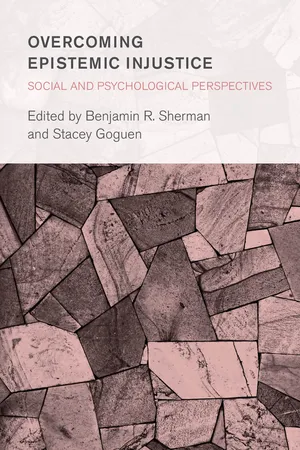
eBook - PDF
Overcoming Epistemic Injustice
Social and Psychological Perspectives
- 335 pages
- English
- PDF
- Available on iOS & Android
eBook - PDF
Overcoming Epistemic Injustice
Social and Psychological Perspectives
About this book
Information
Topic
PhilosophySubtopic
Epistemology in PhilosophyTable of contents
- Contents
- Acknowledgments
- Introduction
- I: Managing Psychological Tendencies
- 1 Negative Epistemic Exemplars
- 2 Positive Stereotypes
- 3 Conceptualizing Consent
- 4 Structural Thinking and Epistemic Injustice
- 5 The Inevitability of Aiming for Virtue
- 6 Can Epistemic Virtues Help Combat Epistemologies of Ignorance?
- II: Curing Epistemic Injustice in Healthcare
- 7 Epistemic Microaggressions and Epistemic Injustices in Clinical Medicine
- 8 Returning to the “There Is”
- 9 Pathocentric Epistemic Injustice and Conceptions of Health
- 10 Uncovering Prejudice and Where It Lives
- 11 Epistemic Injustice in Careers
- III: Arresting Epistemic Injustice in the Legal and Correctional Systems
- 12 The Episteme, Epistemic Injustice, and the Limits of White Sensibility
- 13 Carceral Medicine and Prison Abolition
- 14 Epistemic Injustice and Medical Neglect in Ontario Jails
- IV: Learning to Overcome Epistemic Injustice in Academia, Education, and Sports
- 15 Teaching as Epistemic Care
- 16 When Testimony Isn’t Enough
- 17 Gaslighting as Epistemic Violence
- Afterword
- Index
- About the Contributors
Trusted by 375,005 students
Access to over 1.5 million titles for a fair monthly price.
Study more efficiently using our study tools.
Frequently asked questions
Yes, you can cancel anytime from the Subscription tab in your account settings on the Perlego website. Your subscription will stay active until the end of your current billing period. Learn how to cancel your subscription
No, books cannot be downloaded as external files, such as PDFs, for use outside of Perlego. However, you can download books within the Perlego app for offline reading on mobile or tablet. Learn how to download books offline
Perlego offers two plans: Essential and Complete
- Essential is ideal for learners and professionals who enjoy exploring a wide range of subjects. Access the Essential Library with 800,000+ trusted titles and best-sellers across business, personal growth, and the humanities. Includes unlimited reading time and Standard Read Aloud voice.
- Complete: Perfect for advanced learners and researchers needing full, unrestricted access. Unlock 1.5M+ books across hundreds of subjects, including academic and specialized titles. The Complete Plan also includes advanced features like Premium Read Aloud and Research Assistant.
We are an online textbook subscription service, where you can get access to an entire online library for less than the price of a single book per month. With over 1.5 million books across 990+ topics, we’ve got you covered! Learn about our mission
Look out for the read-aloud symbol on your next book to see if you can listen to it. The read-aloud tool reads text aloud for you, highlighting the text as it is being read. You can pause it, speed it up and slow it down. Learn more about Read Aloud
Yes! You can use the Perlego app on both iOS and Android devices to read anytime, anywhere — even offline. Perfect for commutes or when you’re on the go.
Please note we cannot support devices running on iOS 13 and Android 7 or earlier. Learn more about using the app
Please note we cannot support devices running on iOS 13 and Android 7 or earlier. Learn more about using the app
Yes, you can access Overcoming Epistemic Injustice by Benjamin R. Sherman,Stacey Goguen in PDF and/or ePUB format, as well as other popular books in Philosophy & Epistemology in Philosophy. We have over 1.5 million books available in our catalogue for you to explore.