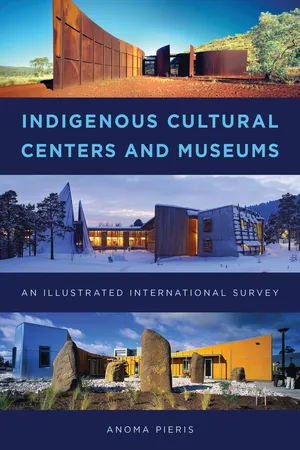
Here is a lavishly illustrated descriptive survey of 48 leading indigenous cultural centers around the world (35 are from Australia and 13 from North America, Japan, Europe, and Asia). The book shows how each is a potentially transformative, politically compelling addition to the field of cultural production, illustrating how the facilities --- all built in the last three decades --- have challenged assumptions about nature, culture, and built form. Using the spatial-temporal practice of place-making as the starting point, the facilities highlighted here are described in terms of collaborations between a number of stake-holders and professional consultants.
The book adopts the format of a descriptive survey with separate chapters devoted to individual case studies. A broad introductory chapter which presents the arguments and overview precedes richly illustrated short individual essays on selected projects. Each chapter commences with the details of the project including, location, area, cost and consultants, followed by a project description, and discussion of background, design development and reception of the projects. Each project is approached as an architectural commission, detailing the critical criteria, consultants, and processes. The format is adopted from architectural review essays typically used in awards or journal publications within the profession which are accessible and relevant for both academics and practitioners. Considerable attention is given to the process, and to the evaluation of the project as a cultural response. Each case study has been written with consultation of architects or administrators of the facilities for accuracy.
Indigenous Cultural Centers and Museums: An Illustrated International Survey documents a rich legacy of collaboration across the spatial disciplines combining creative art practice, architecture, construction, landscape design and urban design in the production of unique and culturally significant social institutions. This book provides material on hitherto unknown bodies of work of talented architectural practices, working collaboratively with culturally different client groups and developing consultative processes that test models for inter-cultural engagement.
- 329 pages
- English
- PDF
- Available on iOS & Android
eBook - PDF
About this book
Information
Table of contents
- Contents
- List of Figures
- List of Plates
- Preface
- Acknowledgments
- Introduction: Architectures of Survivance: An Antipodean Perspective
- Chapter 1. Aboriginal Tent Embassy, Canberra, Australia
- Chapter 2. Australian Institute of Aboriginal and Torres Strait Islander Studies and National Museum of Australia, Canberra, Australia
- Chapter 3. Bangerang Cultural Centre, Shepparton, Victoria, Australia
- Chapter 4. Bowali Visitor Centre, Kakadu National Park, Northern Territory, Australia
- Chapter 5. Brambuk Cultural Centre, Halls Gap, Grampians National Park, Victoria, Australia
- Chapter 6. Brewarrina Aboriginal Museum, Brewarrina, New South Wales, Australia
- Chapter 7. Burrinja Cultural Centre, Glenfern Road, Upwey, Victoria, Australia
- Chapter 8. Edge of the Trees, Museum of Sydney, New South Wales, Australia
- Chapter 9. Galina Beek Living Cultural Centre, Healesville, Victoria, Australia
- Chapter 10. Gunung-Willam-Balluk Learning Centre, Broadmeadows, Victoria, Australia
- Chapter 11. Gwoonwardu Mia Gascoyne Aboriginal Heritage and Cultural Centre, Carnarvon, Western Australia, Australia
- Chapter 12. Jean-Marie Tjibaou Cultural Centre, Nouméa, New Caledonia
- Chapter 13. Karijini Visitor Centre, Karijini, Western Australia, Australia
- Chapter 14. Koorie Heritage Trust, Federation Square, Melbourne, Victoria, Australia
- Chapter 15. Kurongkurl Katitjin Centre for Indigenous Australian Education and Research, Edith Cowan University, Mount Lawley, Western Australia, Australia
- Chapter 16. Lake Tyers Training Centre and Lake Tyers Health Centre, Lake Tyers, Victoria, Australia
- Chapter 17. Living Kaurna Cultural Centre, Bedford Park, South Australia, Australia
- Chapter 18. Minpaku (National Museum of Ethnology), Osaka, Japan
- Chapter 19. Mossman Gorge Centre, Mossman, Queensland, Australia
- Chapter 20. Musée du Quai Branly and Universitè Wing, Paris, France
- Chapter 21. Museum of Anthropology, University of British Columbia, Vancouver, Canada
- Chapter 22. Museum of New Zealand Te Papa Tongarewa, Wellington, New Zealand
- Chapter 23. Musgrave Park, South Brisbane, Queensland, Australia
- Chapter 24. National Centre of Indigenous Excellence, Redfern, New South Wales, Australia
- Chapter 25. National Museum of the American Indian, New York and Washington, DC, and Cultural Resources Center, Maryland, United States of America
- Chapter 26. Needwonnee Walk, Melaleuca, Tasmania, Australia
- Chapter 27. Ngarluma Yindjibarndi Cultural Complex, Roebourne, Western Australia, Australia
- Chapter 28. Nk’Mip Desert Cultural Centre, Osoyoos, Canada
- Chapter 29. Port Augusta Courts, Port Augusta, South Australia, Australia
- Chapter 30. Reconciliation Place, Canberra, Australia
- Chapter 31. Riawunna Centre, University of Tasmania, Launceston, Tasmania, Australia
- Chapter 32. Rumbalara Medical Clinic, Mooroopna and Rumbalara Elders Care Facility, Shepparton, Victoria, Australia
- Chapter 33. Sámi Parliaments, Norway, Sweden, and Finland
- Chapter 34. Shung Ye Museum of Formosan Aborigines, Taipei, Taiwan
- Chapter 35. Tiagarra Aboriginal Cultural Centre and Museum, Devonport, Tasmania, Australia
- Chapter 36. Tjapukai Aboriginal Cultural Park, Caravonica, Queensland, Australia
- Chapter 37. Tjulyuru Cultural and Civic Centre, Warburton Aboriginal Community, Western Australia, Australia
- Chapter 38. Uluru-Kata Tjuta Cultural Centre, Northern Territory, Australia
- Chapter 39. Wilcannia Health Service, Wilcannia, New South Wales, Australia
- Chapter 40. Worn Gundidj, Tower Hill, Victoria, Australia
- Chapter 41. Yagan Memorial Park, Belhus, Western Australia, Australia
- Glossary of Terms
- Bibliography
- About the Editors and Contributors
Trusted by 375,005 students
Access to over 1.5 million titles for a fair monthly price.
Study more efficiently using our study tools.
Frequently asked questions
Yes, you can cancel anytime from the Subscription tab in your account settings on the Perlego website. Your subscription will stay active until the end of your current billing period. Learn how to cancel your subscription
No, books cannot be downloaded as external files, such as PDFs, for use outside of Perlego. However, you can download books within the Perlego app for offline reading on mobile or tablet. Learn how to download books offline
Perlego offers two plans: Essential and Complete
- Essential is ideal for learners and professionals who enjoy exploring a wide range of subjects. Access the Essential Library with 800,000+ trusted titles and best-sellers across business, personal growth, and the humanities. Includes unlimited reading time and Standard Read Aloud voice.
- Complete: Perfect for advanced learners and researchers needing full, unrestricted access. Unlock 1.5M+ books across hundreds of subjects, including academic and specialized titles. The Complete Plan also includes advanced features like Premium Read Aloud and Research Assistant.
We are an online textbook subscription service, where you can get access to an entire online library for less than the price of a single book per month. With over 1.5 million books across 990+ topics, we’ve got you covered! Learn about our mission
Look out for the read-aloud symbol on your next book to see if you can listen to it. The read-aloud tool reads text aloud for you, highlighting the text as it is being read. You can pause it, speed it up and slow it down. Learn more about Read Aloud
Yes! You can use the Perlego app on both iOS and Android devices to read anytime, anywhere — even offline. Perfect for commutes or when you’re on the go.
Please note we cannot support devices running on iOS 13 and Android 7 or earlier. Learn more about using the app
Please note we cannot support devices running on iOS 13 and Android 7 or earlier. Learn more about using the app
Yes, you can access Indigenous Cultural Centers and Museums by Anoma Pieris in PDF and/or ePUB format, as well as other popular books in Business & Museum Administration. We have over 1.5 million books available in our catalogue for you to explore.