"We, however, place the love of God and His honour above our own and above the acquisition of many regions." – Richard the Lionheart
A lot of ink has been spilled covering the lives of history's most influential figures, but how much of the forest is lost for the trees? In Charles River Editors' Legends of the Middle Ages series, readers can get caught up to speed on the lives of important medieval men and women in the time it takes to finish a commute, while learning interesting facts long forgotten or never known.
The enduring figure of the Middle Ages is the chivalrous knight, who played the role of hero across much of Europe and was equal parts courage and valor. Nobody played a more defining role in casting the popular image of medieval knights than Richard the Lionheart, one of the most famous English kings and crusaders. In many respects, it was ironic that Richard became one of the central characters of the Middle Ages, and his very popular legacy today belies centuries of controversy.
Richard I Plantagenet (1157-1199), nicknamed "Coeur de Lion" (Lionheart), eventually became King of England, Grand Duke of Aquitaine, Duke of Poitou, and Duke of Anjou, but as the third son in a large family, he did not expect to or even want to rule England. Nevertheless, it was he who eventually came to the throne upon his father's death. Richard lived in an age when knights were first asserting themselves as capable of being moral forces for good rather than only agents of chaos. This attitude resolved itself into the mystique of chivalry. As one of the strongest knights of his age, Richard was also considered a flower of chivalry and greatly admired as a model of what it meant to be a knight, both in his lifetime and afterward. But as the son of the most famous power couple of the age – Henry II of England (1133-89) and Eleanor of Aquitaine (1122/24-1204) – and an expansionist noble contesting over land with other expansionist nobles, he also had many enemies. These enemies portrayed Richard as evil incarnate, at the same time his admirers were portraying him an emblem of virtue. As with all such great and controversial figures, the real Richard lay somewhere in between.
In many parts of the world today, Richard the Lionheart is remembered not for being a medieval king but for being perhaps the Crusades' most famous European figher. In the Third Crusade, Richard was pitted against the best known Muslim leader in history, Saladin, who like Richard was considered a flower of chivalry by some, a tyrant by others, and even a herald of the Antichrist by Christians. Richard and Saladin's contest was cast by their contemporaries as a battle between Good and Evil (though who was Good and who was Evil depended greatly on the source), but eventually the legend and lore of mutual respect between the two and popular depictions of both leaders helped cement their legacies. Richard's eventual reputation was bound up as much in the crusading spirit of his age as in his reputation as a fearsome warrior or the history of his tumultuous family. If anything, stories like The Lion in Winter have oversimplified the complex Plantagenets who were Richard's closest kin.
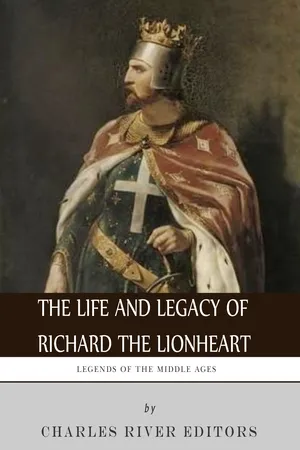
Legends of the Middle Ages: The Life and Legacy of Richard the Lionheart chronicles the historic life and reign of the famous leader, and it analyzes his influential and enduring legacy. Along with pictures of important people, places, and events, you will learn about Richard like you never have before, in no time at all.