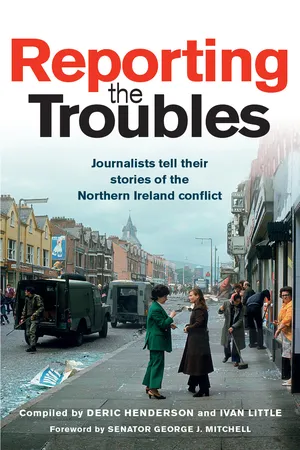
Reporting the Troubles 1
eBook - ePub

Reporting the Troubles 1

Journalists tell their stories of the Northern Ireland conflict

  1. English
  2. ePUB (mobile friendly)
  3. Available on iOS & Android
eBook - ePub

Reporting the Troubles 1

Journalists tell their stories of the Northern Ireland conflict

About this book

In some ways, I didn't – don't – want to remember any of it. Which is not to say that one ever forgets. I don't know any journalist who worked through the Troubles, with its relentless cycle of murders and doorstepping the homes of the dead and funerals and yet more murders, who isn't haunted from time to time by being an eyewitness to evil, to heartache and, yes, to courage too.

GAIL WALKER, editor, Belfast Telegraph

In Reporting the Troubles sixty-eight renowned journalists tell their stories of working in Northern Ireland during the Troubles – the victims that they have never forgotten, the events that have never left them, and the lasting impact of the experience of working through those years.

The result is a compelling account of one of the most turbulent periods in recent history, told by the journalists who reported on it. Beginning in 1968 with an eyewitness report of the day that civil rights protestors clashed with the police in Derry, the journalists give candid accounts of the years that followed – arriving on the scene of major atrocities; knocking on the doors of bereaved relatives; maintaining objectivity in the face of threats from paramilitaries and pressure from the state; and always the absolute commitment to telling the truth.

This is a landmark book – a history of the Troubles told by the journalists who were on the ground from the beginning and including many of the biggest names in journalism from the last fifty years. Reporting the Troubles is a remarkable act of remembrance that is raw, thought provoking and profoundly moving.

Contributors:

Kate Adie, Martin Bell, Nicholas Denis, Sean O'Neill, David Armstrong, Wendy Austin, Trevor Birney, Suzanne Breen, Gordon Burns, Anne Cadwallader, Michael Cairns, Jim Campbell, Paul Clark, John Coghlan, Martin Cowley, Ed Curran, David Davin-Power, DeaglĂĄn de BrĂ©adĂșn, John Devine, Noel Doran, Noreen Erskine, Paul Faith, Robert Fisk, Derval Fitzsimons, Tommie Gorman, Katie Hannon, Deric Henderson, Eamonn Holmes, Gloria Hunniford, John Irvine, Jeanie Johnston, Alan Jones, Hugh Jordan, Richard Kay, Martin Lindsay, Ivan Little, Jane Loughrey, Eamonn Mallie, Ray Managh, Steven McCaffery, Justine McCarthy, Alf McCreary, Denzil McDaniel, Henry McDonald, Jim McDowell, Eddie McIlwaine, Susan McKay, David McKittrick, Ivan McMichael, Gerry Moriarty, John Mullin, Bill Neely, Miriam O'Callaghan, Conor O'Clery, Sister Martina Purdy, Ken Reid, Brian Rowan, Chris Ryder, Gerald Seymour, Sam Smyth, Peter Taylor, Alex Thomson, Chris Moore, Gail Walker, David Walmsley, Ian Woods, Robin Walsh.

Frequently asked questions

Yes, you can cancel anytime from the Subscription tab in your account settings on the Perlego website. Your subscription will stay active until the end of your current billing period. Learn how to cancel your subscription.
No, books cannot be downloaded as external files, such as PDFs, for use outside of Perlego. However, you can download books within the Perlego app for offline reading on mobile or tablet. Learn more here.
Perlego offers two plans: Essential and Complete
  • Essential is ideal for learners and professionals who enjoy exploring a wide range of subjects. Access the Essential Library with 800,000+ trusted titles and best-sellers across business, personal growth, and the humanities. Includes unlimited reading time and Standard Read Aloud voice.
  • Complete: Perfect for advanced learners and researchers needing full, unrestricted access. Unlock 1.4M+ books across hundreds of subjects, including academic and specialized titles. The Complete Plan also includes advanced features like Premium Read Aloud and Research Assistant.
Both plans are available with monthly, semester, or annual billing cycles.
We are an online textbook subscription service, where you can get access to an entire online library for less than the price of a single book per month. With over 1 million books across 1000+ topics, we’ve got you covered! Learn more here.
Look out for the read-aloud symbol on your next book to see if you can listen to it. The read-aloud tool reads text aloud for you, highlighting the text as it is being read. You can pause it, speed it up and slow it down. Learn more here.
Yes! You can use the Perlego app on both iOS or Android devices to read anytime, anywhere — even offline. Perfect for commutes or when you’re on the go.
Please note we cannot support devices running on iOS 13 and Android 7 or earlier. Learn more about using the app.
Yes, you can access Reporting the Troubles 1 by Deric Henderson,Ivan Little in PDF and/or ePUB format, as well as other popular books in History & Media & Communications Industry. We have over one million books available in our catalogue for you to explore.

Information

Table of contents

  1. Dedication
  2. Copyright Page
  3. Contents
  4. Foreword
  5. Introduction
  6. Duke Street, Derry, 5 October 1968
  7. How an ex-B Special owes his life to a lady on the Falls Road
  8. The night Paisley said I worked for the Papist Broadcasting Corporation
  9. The ‘honey-trap’ killings of three Scottish soldiers
  10. An Irish Setter, a Palestinian hijacker, Derry and me
  11. The crews of old
  12. Bloody Sunday
  13. ‘Get that Irish bitch off the air or someone else will’
  14. Uncle Ted
  15. Were the murderers in the room?
  16. The little boy who witnessed an attempt on a neighbour’s life
  17. The Bloody Friday survivors who inspired me
  18. The day the army missed the IRA’s top commander
  19. When Edward Heath branded Paisley ‘a disloyalist’
  20. How Paisley turned the jeers to cheers for me
  21. My night with a loyalist drag queen and the ‘beast from hell’
  22. An almost fatal knockout
  23. The broken spectacles that trapped a Miami Showband killer
  24. The beginning of 1976
  25. ‘Why does there have to be bad people in the world? My daddy was good.’
  26. Hidden in the ashes – my terrible reminder of La Mon
  27. The day the IRA killed Lord Mountbatten, two teenagers, an elderly woman and eighteen soldiers
  28. Gunned down at a football match
  29. The murder of my neighbour, Robert Bradford MP
  30. ‘Daddy won’t get up’ – murder under a Christmas tree
  31. The dirty little secret and the tears of a cub reporter
  32. Taking flight with Margaret Thatcher
  33. The Maze jailbreak
  34. The massacre at Darkley – and the nature of certainty
  35. IRA war against border Protestants
  36. Death on my doorstep
  37. ‘We’ll get you next time, Campbell’
  38. Martin McGuinness in 1986
  39. The Enniskillen Remembrance Day bombing
  40. Knocking doors and intruding on grief
  41. The lasting impact of the Troubles on my life
  42. Taking cover during Michael Stone’s attack at Milltown
  43. Remembering Jillian Johnston
  44. I still get flashbacks to ‘the corporals’ killings’
  45. The Gibraltar shootings: taking on the censors
  46. My brushes with Margaret Thatcher and Prince Charles
  47. The killing I’ll never forget
  48. Sean Graham’s, Ormeau Road, 1992
  49. The day the UVF told me, ‘We bombed Dublin and Monaghan’
  50. An Irish reporter in the English pack
  51. Torment in a country graveyard
  52. Ten funerals in one working week
  53. ‘The safest place to be was on the pitch’
  54. The Chinook air tragedy
  55. David Trimble – the unlikely peacemaker
  56. Clinton’s men tried to arrest me under the Christmas lights
  57. The five ‘P O’Neills’ who briefed me about the IRA
  58. How Drumcree changed my home town
  59. A birthday present for Billy Wright
  60. George Mitchell – the man who lit up the peace process
  61. We were uniquely privileged to do this work
  62. An epitaph of sorts
  63. Good Friday – a day and night like no other
  64. Omagh remembered
  65. And then there was Omagh
  66. A touch of magic as Hume and Trimble collect their Nobel Peace Prize
  67. Rosemary Nelson’s last interview
  68. Chronicling the lost lives of the Troubles
  69. The tears of Martin McGuinness’s mother
  70. The murder of Martin O’Hagan
  71. I could see the picture unfold before it happened
  72. Bringing Gerard Evans home to his mother
  73. My meeting with the woman twice widowed by the UVF
  74. Missing the obvious
  75. Remembering the victims in the postscript of peace
  76. Acknowledgements