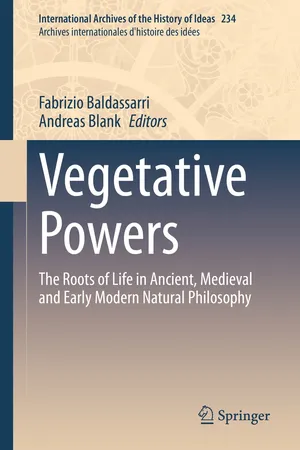
The volume analyzes the natural philosophical accounts and debates concerning the vegetative powers, namely nutrition, growth, and reproduction. While principally focusing on the early modern approaches to the lower functions of the soul, readers will discover the roots of these approaches back to the Ancient times, as the volume highlights the role of three strands that help shape the study of life in the Medieval and early modern natural philosophies. From late antiquity to the early modern period, the vegetative soul and its cognate concepts have played a substantial role in specifying life, living functions, and living bodies, sometimes blurring the line between living and non-living nature, and, at other moments, resulting in a strong restriction of life to a mechanical system of operations and powers. Unearthing the history of the vegetative soul as a shrub of interconnected concepts, the 24 contributions of the volume fill a crucial gap in scholarship, ultimately outlining the importance of vegetal processes of incessant proliferation, generation, and organic growth as the roots of life in natural philosophical interpretations.
eBook - ePub
Vegetative Powers
The Roots of Life in Ancient, Medieval and Early Modern Natural Philosophy
- English
- ePUB (mobile friendly)
- Available on iOS & Android
eBook - ePub
Vegetative Powers
The Roots of Life in Ancient, Medieval and Early Modern Natural Philosophy
About this book
Information
Topic
PhilosophyTable of contents
- Cover
- Front Matter
- 1. Missing a Soul That Endows Bodies with Life: An Introduction
- 2. Soul, Parts of the Soul, and the Definition of the Vegetative Capacity in Aristotle’s De anima
- 3. Embodied Intelligent (?) Souls: Plants in Plato’s Timaeus
- 4. The Vegetative Soul in Galen
- 5. Avicenna on Vegetative Faculties and the Life of Plants
- 6. Can Plants Desire? Aspects of the Debate on desiderium naturale
- 7. Disclosing the Hidden Life of Plants. Theories of the Vegetative Soul in Albert the Great’s De vegetabilibus et plantis
- 8. On the Natural Generation of Human Beings: The Vegetative Power in a Thought Experiment by Some Masters of Arts (1250-c. 1268)
- 9. Thomas Aquinas on the Vegetative Soul
- 10. The Vegetative Powers of Human Beings: Late Medieval Metaphysical Worries
- 11. The Jesuit Cultivation of Vegetative Souls: Leonard Lessius (1554–1623) on a Sober Diet
- 12. Nicolaus Taurellus on Vegetative Powers and the Question of Substance Monism
- 13. Vegetal Analogy in Early Modern Medicine: Generation as Plant Cutting in Sennert’s Early Treatises (1611–1619)
- 14. Vegetative and Sensitive Functions of the Soul in Descartes’s Meditations
- 15. Failures of Mechanization: Vegetative Powers and the Early Cartesians, Regius, La Forge, and Schuyl
- 16. Marin Cureau de la Chambre on the Vegetative Powers
- 17. Re-inventing the Vegetable Soul? More’s Spirit of Nature and Cudworth’s Plastic Nature Reconsidered
- 18. Margaret Cavendish and Vegetable Life
- 19. Plantanimal Imagination: Life and Perception in Early Modern Discussions of Vegetative Power
- 20. “Vegetative Epistemology”: Francis Glisson on the Self-Referential Nature of Life
- 21. Life in the Dark: Corals, Sponges, and Gravitation in Late Seventeenth Natural Philosophy
- 22. Vegetable Life: Applications, Implications, and Transformations of a Classical Concept (1500–1700)
- 23. The Notion of Vegetative Soul in the Leibniz-Stahl Controversy
- 24. Vegetation and Life from Wolff to Hanov
- 25. Bichatʼs Two Lives
Trusted by 375,005 students
Access to over 1.5 million titles for a fair monthly price.
Study more efficiently using our study tools.
Frequently asked questions
Yes, you can cancel anytime from the Subscription tab in your account settings on the Perlego website. Your subscription will stay active until the end of your current billing period. Learn how to cancel your subscription
No, books cannot be downloaded as external files, such as PDFs, for use outside of Perlego. However, you can download books within the Perlego app for offline reading on mobile or tablet. Learn how to download books offline
Perlego offers two plans: Essential and Complete
- Essential is ideal for learners and professionals who enjoy exploring a wide range of subjects. Access the Essential Library with 800,000+ trusted titles and best-sellers across business, personal growth, and the humanities. Includes unlimited reading time and Standard Read Aloud voice.
- Complete: Perfect for advanced learners and researchers needing full, unrestricted access. Unlock 1.5M+ books across hundreds of subjects, including academic and specialized titles. The Complete Plan also includes advanced features like Premium Read Aloud and Research Assistant.
We are an online textbook subscription service, where you can get access to an entire online library for less than the price of a single book per month. With over 1.5 million books across 990+ topics, we’ve got you covered! Learn about our mission
Look out for the read-aloud symbol on your next book to see if you can listen to it. The read-aloud tool reads text aloud for you, highlighting the text as it is being read. You can pause it, speed it up and slow it down. Learn more about Read Aloud
Yes! You can use the Perlego app on both iOS and Android devices to read anytime, anywhere — even offline. Perfect for commutes or when you’re on the go.
Please note we cannot support devices running on iOS 13 and Android 7 or earlier. Learn more about using the app
Please note we cannot support devices running on iOS 13 and Android 7 or earlier. Learn more about using the app
Yes, you can access Vegetative Powers by Fabrizio Baldassarri,Andreas Blank in PDF and/or ePUB format, as well as other popular books in Philosophy & Medical Theory, Practice & Reference. We have over 1.5 million books available in our catalogue for you to explore.