Historical studies of genocide in the 20th century trace the roots back to the sociopolitical, economic, and cultural developments of the early modern period. From globalization to urbanization, to imperialism, state formation and homogenization, from religious warfare to enlightenment, to racism: many factors connected with genocide first emerged or vastly developed between the 15th and 18th centuries. While the early modern period did not have a crime of genocide, it possessed its own legal system which contemplated the rightful destruction of whole peoples, and a political culture that sanctioned the use of mass violence. As a result, early modern genocide has been denied or blurred as a regrettable side effect of the global circulation of ideas, goods, and peoples, and the creation of new societies, cultures, and languages arising from it.
This collection looks at the different genocides which unfolded around the globe, emphasizing its gendered dimension and its disproportionate and enduring impact on indigenous populations. Although European imperialism and homogenization play a central role, it aims more widely to cover the principal agents, victims and rationale for genocide in the early modern world. As a whole, this volume aims at fostering the debate on the early modern history of genocide, not as an insulated or secondary subject, but as a central issue of the era with profound implications for our own.
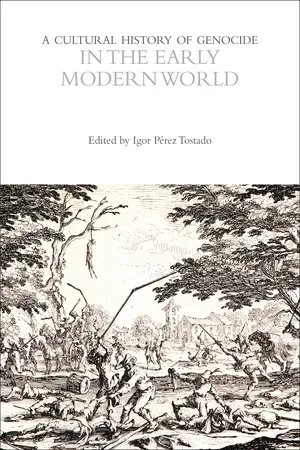
- 265 pages
- English
- PDF
- Available on iOS & Android
eBook - PDF
A Cultural History of Genocide in the Early Modern World
About this book
Information
Table of contents
- Cover
- Contents
- List of Illustrations
- General Editor’s Preface Paul R. Bartrop
- Introduction Igor Pérez Tostado
- 1 Causes Eamon Darcy
- 2 Motivations and Justifications H. E. Braun
- 3 Perpetrators Habtamu Tegegne
- 4 Victims Bindu Malieckal
- 5 Responses Igor Pérez Tostado
- 6 Consequences Christophe Giudicelli
- 7 Representations David El Kenz
- 8 Memory Bartolomé Clavero
- Notes
- Bibliography
- Notes on Contributors
- Index
Trusted by 375,005 students
Access to over 1.5 million titles for a fair monthly price.
Study more efficiently using our study tools.
Frequently asked questions
Yes, you can cancel anytime from the Subscription tab in your account settings on the Perlego website. Your subscription will stay active until the end of your current billing period. Learn how to cancel your subscription
No, books cannot be downloaded as external files, such as PDFs, for use outside of Perlego. However, you can download books within the Perlego app for offline reading on mobile or tablet. Learn how to download books offline
Perlego offers two plans: Essential and Complete
- Essential is ideal for learners and professionals who enjoy exploring a wide range of subjects. Access the Essential Library with 800,000+ trusted titles and best-sellers across business, personal growth, and the humanities. Includes unlimited reading time and Standard Read Aloud voice.
- Complete: Perfect for advanced learners and researchers needing full, unrestricted access. Unlock 1.5M+ books across hundreds of subjects, including academic and specialized titles. The Complete Plan also includes advanced features like Premium Read Aloud and Research Assistant.
We are an online textbook subscription service, where you can get access to an entire online library for less than the price of a single book per month. With over 1.5 million books across 990+ topics, we’ve got you covered! Learn about our mission
Look out for the read-aloud symbol on your next book to see if you can listen to it. The read-aloud tool reads text aloud for you, highlighting the text as it is being read. You can pause it, speed it up and slow it down. Learn more about Read Aloud
Yes! You can use the Perlego app on both iOS and Android devices to read anytime, anywhere — even offline. Perfect for commutes or when you’re on the go.
Please note we cannot support devices running on iOS 13 and Android 7 or earlier. Learn more about using the app
Please note we cannot support devices running on iOS 13 and Android 7 or earlier. Learn more about using the app
Yes, you can access A Cultural History of Genocide in the Early Modern World by Igor Pérez Tostado in PDF and/or ePUB format, as well as other popular books in History & History Reference. We have over 1.5 million books available in our catalogue for you to explore.