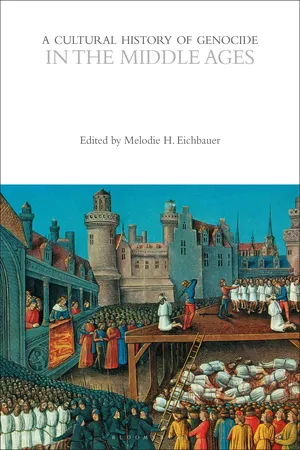
The period covered by this volume, roughly 800-1400, considers genocidal massacres and actions within the context of the pre-modern state, a time when the term "genocide" did not yet exist. In considering rhetoric, discrimination, and political and legal marginalization that impacted the lives of particular peoples, the volume takes as its premise that genocidal practices and massacres can occur when social dynamism and political change challenges the identity of a community.
The case studies analysed in the individual chapters implicitly or explicitly draw upon the frameworks of comparative genocide scholars to explore genocidal massacres in the Middle Ages as localized phenomenon, even if these isolated outbursts do not graph onto the modern definition of genocide perfectly. Each contribution considers genocide as caused by settling national, religious, and ethnic differences; genocide as designed to enforce or fulfil an ideology; and genocide as designed to colonize. Collectively the essays move beyond the number of people killed to consider the steps taken against a people to erase them from the social and cultural fabric of society. It is hoped that this volume encourages us to think both about the legal structures of genocide but also about how the term can be more inclusive and expansive.
- 249 pages
- English
- PDF
- Available on iOS & Android
eBook - PDF
A Cultural History of Genocide in the Middle Ages
About this book
Information
Table of contents
- Cover
- Contents
- List of Illustrations
- General Editor’s Preface Paul R. Bartrop
- Introduction Melodie H. Eichbauer
- 1 Causes Jonathan Elukin
- 2 Motivations and Justifications Edward M. Schoolman
- 3 Perpetrators David Bachrach and Bernard S. Bachrach
- 4 Victims Kenneth Stow
- 5 Responses Anna Sapir Abulafia
- 6 Consequences Alex Mallett
- 7 Representations Alan V. Murray
- 8 Memory Piotr Górecki
- Notes
- Bibliography
- Notes on Contributors
- Index
Trusted by 375,005 students
Access to over 1.5 million titles for a fair monthly price.
Study more efficiently using our study tools.
Frequently asked questions
Yes, you can cancel anytime from the Subscription tab in your account settings on the Perlego website. Your subscription will stay active until the end of your current billing period. Learn how to cancel your subscription
No, books cannot be downloaded as external files, such as PDFs, for use outside of Perlego. However, you can download books within the Perlego app for offline reading on mobile or tablet. Learn how to download books offline
Perlego offers two plans: Essential and Complete
- Essential is ideal for learners and professionals who enjoy exploring a wide range of subjects. Access the Essential Library with 800,000+ trusted titles and best-sellers across business, personal growth, and the humanities. Includes unlimited reading time and Standard Read Aloud voice.
- Complete: Perfect for advanced learners and researchers needing full, unrestricted access. Unlock 1.5M+ books across hundreds of subjects, including academic and specialized titles. The Complete Plan also includes advanced features like Premium Read Aloud and Research Assistant.
We are an online textbook subscription service, where you can get access to an entire online library for less than the price of a single book per month. With over 1.5 million books across 990+ topics, we’ve got you covered! Learn about our mission
Look out for the read-aloud symbol on your next book to see if you can listen to it. The read-aloud tool reads text aloud for you, highlighting the text as it is being read. You can pause it, speed it up and slow it down. Learn more about Read Aloud
Yes! You can use the Perlego app on both iOS and Android devices to read anytime, anywhere — even offline. Perfect for commutes or when you’re on the go.
Please note we cannot support devices running on iOS 13 and Android 7 or earlier. Learn more about using the app
Please note we cannot support devices running on iOS 13 and Android 7 or earlier. Learn more about using the app
Yes, you can access A Cultural History of Genocide in the Middle Ages by Melodie H. Eichbauer in PDF and/or ePUB format, as well as other popular books in History & European Medieval History. We have over 1.5 million books available in our catalogue for you to explore.