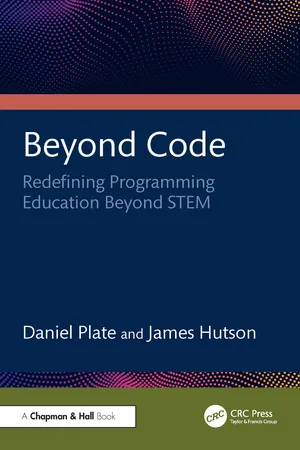
AI-powered coding tools are revolutionizing software development, transforming programming from a specialized skill into an accessible educational practice across disciplines. This book investigates how tools such as Cursor AI, GitHub Copilot, and Replit's Ghostwriter are dismantling traditional barriers to entry for learners—particularly those from non-STEM backgrounds—by enabling natural language code generation, intelligent debugging, and interactive, project-based learning. Bridging the gap between theoretical instruction and practical application, the book serves as both a guide and a critical framework for integrating generative AI into curricula. It highlights how these tools expand the boundaries of programming education by supporting interdisciplinary applications, from literary analysis to creative writing, thereby making coding relevant and actionable for students in the humanities and beyond. The book equips educators with the tools and strategies necessary to incorporate AI-assisted programming into diverse academic contexts by offering lesson plans and adaptable project models. This resource is essential for instructors seeking to demystify coding, promote inclusivity in technical learning, and reimagine the role of software literacy in the twenty-first-century classroom.
- English
- ePUB (mobile friendly)
- Available on iOS & Android
eBook - ePub
About this book
Information
Publisher
Chapman and Hall/CRCYear
2025Print ISBN
9781041068969
9781041069003
Edition
1eBook ISBN
9781040421666
Table of contents
- Cover
- Half-Title
- Title
- Copyright
- Dedication
- Contents
- Preface
- Acknowledgments
- 1 Introduction: The Paradigm Shift—From Syntax to Software Literacy
- 2 The Limitations of Traditional Syntax-Focused Coding Education in Non-STEM
- 3 The Power of AI Coding Assistants: Unlocking Computational Potential for All
- 4 Re-Centering Coding Education in the AI Age
- 5 Practical Examples and Case Studies in Non-STEM Classrooms
- 6 Looking Ahead: The Future of AI-Driven Coding Education
- 7 Conclusion: Embracing Software Literacy as a Foundational Skill for the 21st Century
- Glossary of Key Terms and Concepts
- Index
Trusted by 375,005 students
Access to over 1.5 million titles for a fair monthly price.
Study more efficiently using our study tools.
Frequently asked questions
Yes, you can cancel anytime from the Subscription tab in your account settings on the Perlego website. Your subscription will stay active until the end of your current billing period. Learn how to cancel your subscription
No, books cannot be downloaded as external files, such as PDFs, for use outside of Perlego. However, you can download books within the Perlego app for offline reading on mobile or tablet. Learn how to download books offline
Perlego offers two plans: Essential and Complete
- Essential is ideal for learners and professionals who enjoy exploring a wide range of subjects. Access the Essential Library with 800,000+ trusted titles and best-sellers across business, personal growth, and the humanities. Includes unlimited reading time and Standard Read Aloud voice.
- Complete: Perfect for advanced learners and researchers needing full, unrestricted access. Unlock 1.5M+ books across hundreds of subjects, including academic and specialized titles. The Complete Plan also includes advanced features like Premium Read Aloud and Research Assistant.
We are an online textbook subscription service, where you can get access to an entire online library for less than the price of a single book per month. With over 1.5 million books across 990+ topics, we’ve got you covered! Learn about our mission
Look out for the read-aloud symbol on your next book to see if you can listen to it. The read-aloud tool reads text aloud for you, highlighting the text as it is being read. You can pause it, speed it up and slow it down. Learn more about Read Aloud
Yes! You can use the Perlego app on both iOS and Android devices to read anytime, anywhere — even offline. Perfect for commutes or when you’re on the go.
Please note we cannot support devices running on iOS 13 and Android 7 or earlier. Learn more about using the app
Please note we cannot support devices running on iOS 13 and Android 7 or earlier. Learn more about using the app
Yes, you can access Beyond Code by Daniel Plate,James Hutson in PDF and/or ePUB format, as well as other popular books in Computer Science & Artificial Intelligence (AI) & Semantics. We have over 1.5 million books available in our catalogue for you to explore.