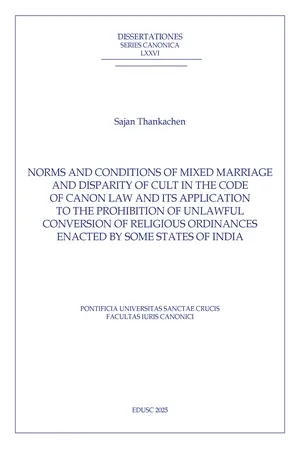
eBook - ePub
Mixed and Disparity of Cult Marriages under India’s State Anti-Conversion Laws
Norms and Conditions of Mixed Marriage and Disparity of Cult in the Code of Canon Law and its Application to the Prohibition of Unlawful Conversion of Religious Ordinances Enacted by Some States of India
- English
- ePUB (mobile friendly)
- Available on iOS & Android
eBook - ePub
Mixed and Disparity of Cult Marriages under India’s State Anti-Conversion Laws
Norms and Conditions of Mixed Marriage and Disparity of Cult in the Code of Canon Law and its Application to the Prohibition of Unlawful Conversion of Religious Ordinances Enacted by Some States of India
About this book
This research examines the Catholic Church's theological, canonical, and pastoral framework regarding interfaith marriages, with a particular focus on matrimonia mixta (marriages between a Catholic and a baptised non-Catholic) and matrimonia cum disparitate cultus (marriages between a Catholic and a non-baptised person). These forms of marriage, though requiring dispensations or permissions under the 1983 Codex Iuris Canonici, reflect the Church's commitment to upholding the right to marry while maintaining fidelity to its sacramental theology. The study emphasises the Church's pastoral approach, which seeks to balance doctrinal integrity with compassion and accompaniment, especially in today's pluralistic societies. Church documents such as Gaudium et Spes and Familiaris Consortio affirm the right to marry and stress the importance of pastoral care and dialogue in interfaith unions.
The research also examines the challenges posed by India's state-level anti-conversion laws, which, although intended to prevent coercion, often infringe on personal religious freedom and marital choice. These laws are frequently misused to target Christian communities, especially amidst suspicion surrounding interfaith marriages involving Catholics. Accusations that the Church uses such marriages for proselytisation are critically analysed and rebutted by examining the Church's actual Canon Law requirements, which explicitly prohibit forced conversions and emphasise respect for the religious conscience of the non-Catholic spouse. Using both Church teachings and Indian legal realities, the thesis reveals how these laws can unjustly restrict the rights of Christians and create hurdles for interreligious families.
The final section presents a critical examination of the ethical and legal tensions between religious freedom, the right to marry, and state intervention in matters of faith and marriage. Drawing on international human rights frameworks and Catholic social teaching, the study underscores the incompatibility of anti-conversion laws with universally recognised personal freedoms. Real-life case studies illustrate the pastoral and legal difficulties encountered by clergy and laity in such situations. The thesis concludes with practical recommendations for the Catholic Bishops' Conference of India (CBCI) and diocesan leadership, advocating for stronger pastoral support, legal literacy, and interreligious cooperation to safeguard the dignity and rights of Catholic spouses in mixed and interfaith marriages.
Information
Table of contents
- ACKNOWLEDGMENTS
- ABBREVIATIONS
- GENERAL INTRODUCTION
- I. HISTORY OF CANONICAL LEGISLATION OF MIXED MARRIAGE AND DISPARITY OF CULT IN THE CODE OF CANON LAW
- II. PROHIBITION OF UNLAWFUL CONVERSION OF RELIGIOUS ORDINANCES IN INDIAPURPOSES AND REASONS FOR ENACTING THESE ORDINANCES
- III. RELIGIOUS PLURALISM AND MATRIMONY IN INDIA: AN EXPLANATION OF MARRIAGE CUSTOMS AND BELIEFS ACROSS MAJOR FAITHS
- IV. DOES THE CATHOLIC CHURCH ALLOW MIXED MARRIAGES AND DISPARITY OF CULT MARRIAGE WITH THE AIM OF CONVERSION? WHAT IS THE LEGAL VALIDITY OF THE SPECIAL MARRIAGE ACT 1954 IN INDIA CONCERNING THE ANTI-CONVERSION BILLS?
- GENERAL CONCLUSION
- BIBLIOGRAPHY
Trusted by 375,005 students
Access to over 1.5 million titles for a fair monthly price.
Study more efficiently using our study tools.
Frequently asked questions
Yes, you can cancel anytime from the Subscription tab in your account settings on the Perlego website. Your subscription will stay active until the end of your current billing period. Learn how to cancel your subscription
No, books cannot be downloaded as external files, such as PDFs, for use outside of Perlego. However, you can download books within the Perlego app for offline reading on mobile or tablet. Learn how to download books offline
Perlego offers two plans: Essential and Complete
- Essential is ideal for learners and professionals who enjoy exploring a wide range of subjects. Access the Essential Library with 800,000+ trusted titles and best-sellers across business, personal growth, and the humanities. Includes unlimited reading time and Standard Read Aloud voice.
- Complete: Perfect for advanced learners and researchers needing full, unrestricted access. Unlock 1.5M+ books across hundreds of subjects, including academic and specialized titles. The Complete Plan also includes advanced features like Premium Read Aloud and Research Assistant.
We are an online textbook subscription service, where you can get access to an entire online library for less than the price of a single book per month. With over 1.5 million books across 990+ topics, we’ve got you covered! Learn about our mission
Look out for the read-aloud symbol on your next book to see if you can listen to it. The read-aloud tool reads text aloud for you, highlighting the text as it is being read. You can pause it, speed it up and slow it down. Learn more about Read Aloud
Yes! You can use the Perlego app on both iOS and Android devices to read anytime, anywhere — even offline. Perfect for commutes or when you’re on the go.
Please note we cannot support devices running on iOS 13 and Android 7 or earlier. Learn more about using the app
Please note we cannot support devices running on iOS 13 and Android 7 or earlier. Learn more about using the app
Yes, you can access Mixed and Disparity of Cult Marriages under India’s State Anti-Conversion Laws by Sajan Thankachen in PDF and/or ePUB format, as well as other popular books in Theology & Religion & Christian Canon & Ecclesiastical Law. We have over 1.5 million books available in our catalogue for you to explore.