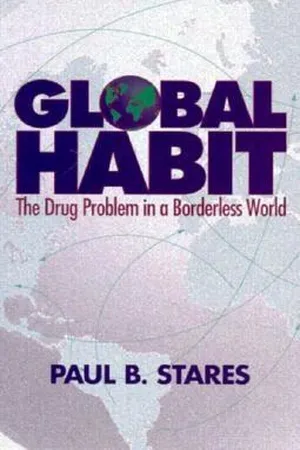
The market for illicit drugs is expanding inexorably around the world. More kinds of drugs are becoming more available in more places than ever before. But the drug trade is not only growing, it is changing in character. It has ceased to be a marginal area of criminal activity and has now become a major global enterprise controlled by formidable interests that threaten much more than the health of drug users. Moreover, the immense wealth that has been amassed from selling drugs has given the principal trafficking organizations enormous power to corrupt and intimidate public officials and government institutions.
In this major book, Paul Stares presents a compelling portrait of the global drug market and the consequences of this international plague. He explains that there are good reasons to fear that the global market for drugs will continue to expand in the coming years: profits to the traffickers are huge; the revolutionary advances in communications, transportation, and information technology facilitate smuggling, as do the lowering of border controls and trade tariffs and the trends toward privatization and deregulation. Meanwhile, the expanded volume of global trade, travel, and financial transactions makes it harder for customs and police authorities to detect and stop illicit activities. Added to the growing incentives and opportunities to supply illicit drugs, the level of demand is increasing in many new areas of the world, particularly in formerly communist countries and many areas of the developing world.
What can done about this growing problem? One option is legalization, but Stares contends that its implementation would be problematic while its benefits remain unclear. Yet, continuing on the present course will not work either. Stares argues that reducing both the supply and demand for illicit drugs requires a fundamental shift away from the current overwhelming emphasis on negative sanctions to deter and deny their production, trafficking, and consumption. Instead, he calls for more positive control measures that primarily rely on persuasion and cooperation. He advocates the creation of a global drug monitoring and evaluation network, a global drug use prevention program, a global drug treatment training program, and an international drug crisis response program.
According to Stares, the effectiveness of reorienting drug control policy to curb the global habit will ultimately depend on the international community's willingness to address much larger concerns to which the drug problem is inextricably linked-- including overpopulation, environmental degradation, poverty, illiteracy, ethnic strife, and disease. Only by recognizing the fundamental relationship between these larger issues and the global drug problem can meaningful progress be made. Selected by Choice as an Outstanding Book for 1996
- 185 pages
- English
- PDF
- Available on iOS & Android
eBook - PDF
About this book
Information
Table of contents
- Cover
- Contents
- 1 The Global Drug Challenge
- 2 The Rise of the Global Drug Market
- 3 Market Dynamics and the Challenge of Control
- 4 The Future of the Global Drug Market
- 5 Responding to the Challenge
- Notes
- Index
Trusted by 375,005 students
Access to over 1.5 million titles for a fair monthly price.
Study more efficiently using our study tools.
Frequently asked questions
Yes, you can cancel anytime from the Subscription tab in your account settings on the Perlego website. Your subscription will stay active until the end of your current billing period. Learn how to cancel your subscription
No, books cannot be downloaded as external files, such as PDFs, for use outside of Perlego. However, you can download books within the Perlego app for offline reading on mobile or tablet. Learn how to download books offline
Perlego offers two plans: Essential and Complete
- Essential is ideal for learners and professionals who enjoy exploring a wide range of subjects. Access the Essential Library with 800,000+ trusted titles and best-sellers across business, personal growth, and the humanities. Includes unlimited reading time and Standard Read Aloud voice.
- Complete: Perfect for advanced learners and researchers needing full, unrestricted access. Unlock 1.5M+ books across hundreds of subjects, including academic and specialized titles. The Complete Plan also includes advanced features like Premium Read Aloud and Research Assistant.
We are an online textbook subscription service, where you can get access to an entire online library for less than the price of a single book per month. With over 1.5 million books across 990+ topics, we’ve got you covered! Learn about our mission
Look out for the read-aloud symbol on your next book to see if you can listen to it. The read-aloud tool reads text aloud for you, highlighting the text as it is being read. You can pause it, speed it up and slow it down. Learn more about Read Aloud
Yes! You can use the Perlego app on both iOS and Android devices to read anytime, anywhere — even offline. Perfect for commutes or when you’re on the go.
Please note we cannot support devices running on iOS 13 and Android 7 or earlier. Learn more about using the app
Please note we cannot support devices running on iOS 13 and Android 7 or earlier. Learn more about using the app
Yes, you can access Global Habit by Paul B. Stares in PDF and/or ePUB format, as well as other popular books in Economics & International Economics. We have over 1.5 million books available in our catalogue for you to explore.