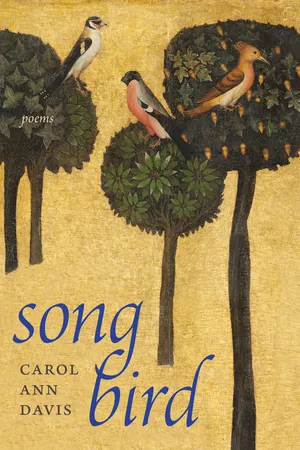
Utilizing the short lyric poem in long sequence, Songbird addresses matters both urgent and ancient: what it is to grow from a child into an adult, how to remain inside one's body, what it means to open the mouth and sing. Guided by the images, senses, and sounds provided to her by the natural world, the poet invents a stuttering natal language to approach the unsayable aspects of interior life. In doing so, the poems collectively trouble the binaries that beset modern existence: the simultaneous push-pull of sexual desire; the interior and exterior landscapes that shape our perceptual fields; the reckoning of violence with beauty; the human need for both permanency and flight. Songbird is a daring and necessary book.
[sample poem]
let me take something small
between my teeth
piece of straw meant to signify your body
which was given freely to me or threads of me
that are wheat strands always these small barters
for a price would I give you the edge that is
your absence for my presence and you between my teeth
for the price of grass the price of all grasses
so say I to you in prayer I would
swallow whole what gave you in part