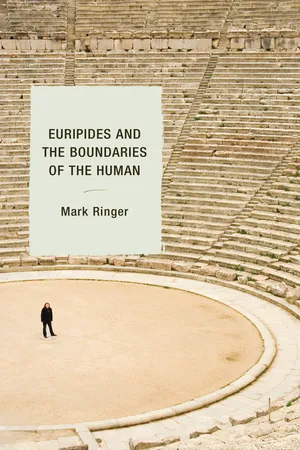
Euripides and the Boundaries of the Human presents the first single-volume reading in nearly fifty years of all of Euripides' surviving plays. Rather than examining one or a handful of dramas in monograph or article form, Mark Ringer insists on the thematic and stylistic parallels that unite a diverse canon of works. Euripides is often referred to as the most modern of the three Ancient Greek tragedians, but in what way can the work of this fifth-century B.C. artist be claimed as modern? The multi-layered presentation of character is new within the context of Athenian Tragedy. The plays also reveal equal concern with the preservation and re-vitalization of tradition, especially with respect to the portrayal of the Olympian gods. Euripidean drama upholds tradition just as vigorously as it posits a new kind of realism in character portrayal in the Ancient Theatre. Euripidean drama fuses what was old with what was new in order to revitalize and perpetuate the art of tragedy.
This book will be of interest to professionals and students in the fields of classics, Greek drama in translation or in the original Greek, theater studies, comparative literature, tragedy, and religion.
- English
- ePUB (mobile friendly)
- Available on iOS & Android
eBook - ePub
Euripides and the Boundaries of the Human
About this book
Information
Topic
PhilosophySubtopic
Ancient & Classical DramaTable of contents
- Title Page
- Preface
- Introduction
- Rhesus (date unknown. 454–440 B.C.?)
- Alcestis (438 B.C.)
- Medea (431 B.C.)
- The Children of Heracles ( Heraclidae , ca. 430 B.C.)
- Hippolytus (428 B.C.)
- Andromache (ca. 425 B.C.)
- Hecuba (ca. 424 B.C.)
- The Suppliant Women (ca. 423 B.C.)
- Electra (ca. 420 B.C.)
- Trojan Women , Part of The “Trojan” Tetralogy (415 B.C.)
- Heracles (ca. 415 B.C.)
- Iphigenia among the Taurians (ca. 414 B.C.)
- Ion (ca. 414 B.C.)
- Helen (412 B.C.)
- The Phoenician Women (ca. 410 B.C.)
- Orestes (408 B.C.)
- The Cyclops (date unknown: 408 B.C.?)
- Iphigenia in Aulis (presented posthumously in 405 B.C.)
- The Bacchae (presented posthumously in 405 B.C.)
- Afterword
- Bibliography
- Index
Trusted by 375,005 students
Access to over 1.5 million titles for a fair monthly price.
Study more efficiently using our study tools.
Frequently asked questions
Yes, you can cancel anytime from the Subscription tab in your account settings on the Perlego website. Your subscription will stay active until the end of your current billing period. Learn how to cancel your subscription
No, books cannot be downloaded as external files, such as PDFs, for use outside of Perlego. However, you can download books within the Perlego app for offline reading on mobile or tablet. Learn how to download books offline
Perlego offers two plans: Essential and Complete
- Essential is ideal for learners and professionals who enjoy exploring a wide range of subjects. Access the Essential Library with 800,000+ trusted titles and best-sellers across business, personal growth, and the humanities. Includes unlimited reading time and Standard Read Aloud voice.
- Complete: Perfect for advanced learners and researchers needing full, unrestricted access. Unlock 1.5M+ books across hundreds of subjects, including academic and specialized titles. The Complete Plan also includes advanced features like Premium Read Aloud and Research Assistant.
We are an online textbook subscription service, where you can get access to an entire online library for less than the price of a single book per month. With over 1.5 million books across 990+ topics, we’ve got you covered! Learn about our mission
Look out for the read-aloud symbol on your next book to see if you can listen to it. The read-aloud tool reads text aloud for you, highlighting the text as it is being read. You can pause it, speed it up and slow it down. Learn more about Read Aloud
Yes! You can use the Perlego app on both iOS and Android devices to read anytime, anywhere — even offline. Perfect for commutes or when you’re on the go.
Please note we cannot support devices running on iOS 13 and Android 7 or earlier. Learn more about using the app
Please note we cannot support devices running on iOS 13 and Android 7 or earlier. Learn more about using the app
Yes, you can access Euripides and the Boundaries of the Human by Mark Ringer in PDF and/or ePUB format, as well as other popular books in Philosophy & Ancient & Classical Drama. We have over 1.5 million books available in our catalogue for you to explore.