*Shortlisted for the 2018 Book Award in Social Sciences of the Central Eurasian Studies Society*
Rewriting the Nation in Modern Kazakh Literature is a book about cultural transformations and trajectories of national imagination in modern Kazakhstan. The book is a much-needed critical introduction and a comprehensive survey of the Kazakh literary production and cultural discourses on the nation in the twentieth and twenty first centuries. In the absence of viable and open forums for discussion and in the turbulent moments of postcolonial and cultural transformation under the Soviets, the Kazakh writers and intellectuals widely engaged with the national identity, heritage and genealogy construction in literature. This active process of national canon construction and its constant re-writing throughout the twentieth century will inform the readers of the complex processes of cultural transformations in forms, genres and texts as well as demonstrating the genealogical development of the national narrative. The main focus of this book is on the cultural production of the nation. The focus is on the narratives of historical continuities produced in the literature and cultural discontinuities and inter-elite competition which inform such production.
The development of Kazakh literary production is an extremely interesting yet underrepresented field of study. Since the late nineteenth century it saw a rapid transformation from the traditional oral to print literature. This brought an unprecedented shift in genres and texts production as well as a rapid growth of the 'writing' class – urban colonial and first generations of Soviet intelligentsia. Kazakh literary production became the flagman of republic's rapid cultural modernization and prior to the World War II local publishing industry produced up to 6 million print copies a year. By the 1960s and 1970s – the golden era of Kazakh literature, the most read literary journal Juldyz sold 50,000 copies all over the country. Literature became the mass provider of knowledge about the past, the present and of the future of the country. Because "Kazakh readers were hungry to find out about their pre-Soviet past and its national glory" national writers competed in genres, styles and ways to write out the nation in prose, poems, essays and historical novels.
eBook - ePub
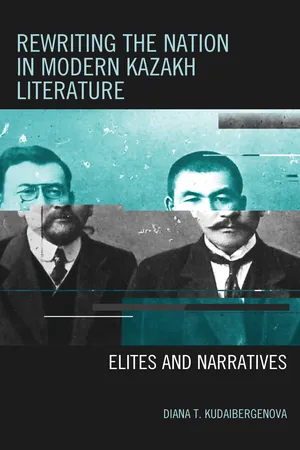
Rewriting the Nation in Modern Kazakh Literature
Elites and Narratives
- English
- ePUB (mobile friendly)
- Available on iOS & Android
eBook - ePub
About this book
Information
Table of contents
- Title Page
- Acknowledgments
- Preface
- Introduction
- Note on Transliteration and Translations
- National Survival, Alash, and Modern Kazakh Literary Debates
- Self-Orientalization and Rewriting of the Narrative
- The Formation of Soviet Kazakh Literary Canon
- Mukhtar Auezov’s Abai Zholy and the Encyclopedia of the Kazakh Nation
- Koshpendiler and the Re-Discovery of the Past
- Magauin’s Cultural Archaeology in Kazakhstan’s National History and Literature
- Internationalism, Post-Colonialism, and Kazakh Soviet Literature in the 1960s and 1980s
- Olzhas Suleimenov and the Un-Bounded Imagination of the Past
- The December 1986 Events and the National Imagination in the Post-Independence Era
- Timeless and Post-National
- Conclusion
- Bibliography
- Index
- About the Author
Trusted by 375,005 students
Access to over 1.5 million titles for a fair monthly price.
Study more efficiently using our study tools.
Frequently asked questions
Yes, you can cancel anytime from the Subscription tab in your account settings on the Perlego website. Your subscription will stay active until the end of your current billing period. Learn how to cancel your subscription
No, books cannot be downloaded as external files, such as PDFs, for use outside of Perlego. However, you can download books within the Perlego app for offline reading on mobile or tablet. Learn how to download books offline
Perlego offers two plans: Essential and Complete
- Essential is ideal for learners and professionals who enjoy exploring a wide range of subjects. Access the Essential Library with 800,000+ trusted titles and best-sellers across business, personal growth, and the humanities. Includes unlimited reading time and Standard Read Aloud voice.
- Complete: Perfect for advanced learners and researchers needing full, unrestricted access. Unlock 1.5M+ books across hundreds of subjects, including academic and specialized titles. The Complete Plan also includes advanced features like Premium Read Aloud and Research Assistant.
We are an online textbook subscription service, where you can get access to an entire online library for less than the price of a single book per month. With over 1.5 million books across 990+ topics, we’ve got you covered! Learn about our mission
Look out for the read-aloud symbol on your next book to see if you can listen to it. The read-aloud tool reads text aloud for you, highlighting the text as it is being read. You can pause it, speed it up and slow it down. Learn more about Read Aloud
Yes! You can use the Perlego app on both iOS and Android devices to read anytime, anywhere — even offline. Perfect for commutes or when you’re on the go.
Please note we cannot support devices running on iOS 13 and Android 7 or earlier. Learn more about using the app
Please note we cannot support devices running on iOS 13 and Android 7 or earlier. Learn more about using the app
Yes, you can access Rewriting the Nation in Modern Kazakh Literature by Diana T. Kudaibergenova in PDF and/or ePUB format, as well as other popular books in History & Central Asian History. We have over 1.5 million books available in our catalogue for you to explore.