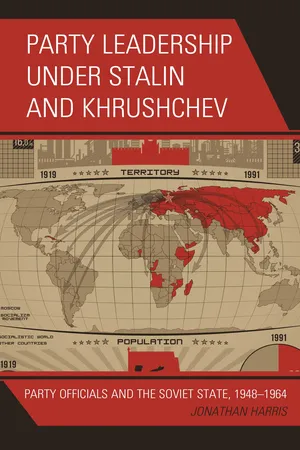
eBook - ePub
Party Leadership under Stalin and Khrushchev
Party Officials and the Soviet State, 1948–1964
- English
- ePUB (mobile friendly)
- Available on iOS & Android
eBook - ePub
Party Leadership under Stalin and Khrushchev
Party Officials and the Soviet State, 1948–1964
About this book
This study demonstrates that the full time party officials of the Communist Party of the Soviet Union (CPSU) used the term "party leadership" to both disguise and signal their efforts to lead the Communists who manned the Soviet state. In 1946, Stalin had made the newly formed Council of Ministers of the USSR, led by its Bureau (Presidium) directly responsible for planning and administering the Soviet economy. As a result, the full time officials clashed constantly and publicly over the relative importance of their direct intervention in production as opposed to ideological education and personnel management in their efforts to provide "party leadership" of the state from 1946 until 1964. Zhdanov and Malenkov clashed over the issue until Zhdanov's death in 1948 and Malenkov clashed with Khrushchev over the same issue from 1949 until Stalin's death in 1953. This conflict became more explicit once Malenkov was named Chairman of the Council of Ministers and Khrushchev first secretary of the CC/CPSU in 1953 and continued until Malenkov's ouster in 1955. Khrushchev clashed with Chairman Bulganin over the same issue from 1955 until 1958. Khrushchev's decision to replace Bulganin as Chairman of the Council of Ministers not only complicated the discussion of party officials' role but led to a series of extremely contradictory reforms. Khrushchev simultaneously bolstered party officials' capacity to intervene directly in industrial production and strengthened the Council of Ministers' control over the same process. The ensuring administrative confusion, when coupled with Khrushchev's overt disdain for the ideological education of Communists helped to undermine his authority and led to the decision of his colleagues to oust him in 1964.
Information
Table of contents
- Contents
- Preface
- Introduction: The Origins of Conflict
- 1 Khrushchev vs. Malenkov, 1948–1953
- 2 Chairman Malenkov vs. First Secretary Khrushchev, 1953–1955
- 3 The 20th Congress of the CPSU. Khrushchev Defines His Priorities, 1956–1957
- 4 Khrushchev as Chairman of the Council of Ministers, 1958
- 5 The Impact of the U-2 Crisis: The 22nd Congress of the CPSU
- 6 Conflicts over Ideology and the Shrinkage and the Reform of the Apparat: The Return to Central State Control, 1961–1963
- 7 The CC/CPSU Plenum on Ideological Work (June 1963). Khrushchev’s Last Year
- Summary and Conclusion
- Bibliography
- Index
- About the Author
Trusted by 375,005 students
Access to over 1.5 million titles for a fair monthly price.
Study more efficiently using our study tools.
Frequently asked questions
Yes, you can cancel anytime from the Subscription tab in your account settings on the Perlego website. Your subscription will stay active until the end of your current billing period. Learn how to cancel your subscription
No, books cannot be downloaded as external files, such as PDFs, for use outside of Perlego. However, you can download books within the Perlego app for offline reading on mobile or tablet. Learn how to download books offline
Perlego offers two plans: Essential and Complete
- Essential is ideal for learners and professionals who enjoy exploring a wide range of subjects. Access the Essential Library with 800,000+ trusted titles and best-sellers across business, personal growth, and the humanities. Includes unlimited reading time and Standard Read Aloud voice.
- Complete: Perfect for advanced learners and researchers needing full, unrestricted access. Unlock 1.5M+ books across hundreds of subjects, including academic and specialized titles. The Complete Plan also includes advanced features like Premium Read Aloud and Research Assistant.
We are an online textbook subscription service, where you can get access to an entire online library for less than the price of a single book per month. With over 1.5 million books across 990+ topics, we’ve got you covered! Learn about our mission
Look out for the read-aloud symbol on your next book to see if you can listen to it. The read-aloud tool reads text aloud for you, highlighting the text as it is being read. You can pause it, speed it up and slow it down. Learn more about Read Aloud
Yes! You can use the Perlego app on both iOS and Android devices to read anytime, anywhere — even offline. Perfect for commutes or when you’re on the go.
Please note we cannot support devices running on iOS 13 and Android 7 or earlier. Learn more about using the app
Please note we cannot support devices running on iOS 13 and Android 7 or earlier. Learn more about using the app
Yes, you can access Party Leadership under Stalin and Khrushchev by Jonathan Harris in PDF and/or ePUB format, as well as other popular books in History & Russian History. We have over 1.5 million books available in our catalogue for you to explore.