The Cold War is often viewed in absolutist terminology: the United States and the Soviet Union characterized one another in oppositional rhetoric and pejorative propaganda. State-sanctioned communications stressed the inherent dissimilarity between their own citizens and those of their Cold War foe. Such rhetoric exacerbated geopolitical tensions and heightened Cold War paranoia, most notably during the Red Scare and brinkmanship incidents. Government leaders stressed the reactive defensive foreign policies they implemented to retaliate against their counterparts' offensive maneuvers. Only brief periods of détente gave glimpses into the possibility of concerted peaceful coexistence.
Yet such characterizations neglect the complexities and rhetorical nuances that created fissures throughout the long-standing ideological conflict. Grassroots diplomacy rarely coalesced with official governmental rhetoric and often contradicted the discourse emanating from the White House and the Kremlin. Organizations such as Women Strike for Peace (WSP), the Committee for Nonviolent Action (CNVA), and the Moscow Trust Group (MTG) defied policy directives and sought to establish genuine peaceful coexistence. Traveling citizens posited that U.S. and Soviet citizens possessed more underlying commonalities than their governmental leaders cared to admit – phenomena underscored in events such as the San-Francisco-to-Moscow Walk for Peace. Spacebridge programs railed against the Strategic Defense Initiative (SDI) and proclaimed that figurative and literal links between their country and the "Other" proved more conducive to public opinion than "Star Wars."
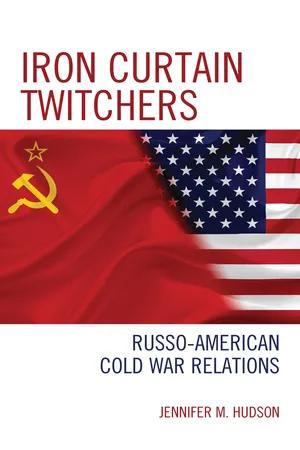
Iron Curtain Twitchers examines such juxtaposing rhetorics through three lexical themes: contamination, containment, and coexistence. It analyzes the disparate perspectives of public politicians and private citizens throughout the Cold War's duration and its aftermath to better understand the political, cultural, and geopolitical nuances of U.S.-Russia relations. Vacillating rhetoric among politicians, journalists, and traveling citizens complicated geopolitical relationships, sociopolitical disagreements, and cultural characterizations. These dialogues are contrasted with the cultural mediums of film and political cartoons to underscore fluctuating Cold War identity dynamics. Manifestations of one's own country contrasted with propagations of the "Other" and indicate that the Cold War lasted much longer and remains more virulent than previously conceived.
- English
- ePUB (mobile friendly)
- Available on iOS & Android
eBook - ePub
About this book
Information
Table of contents
- Cover
- HalfTitle
- Title
- Copyright
- Dedication
- Contents
- List of Figures
- Acknowledgments
- List of Abbreviations
- Note on Transliteration
- Introduction
- 1 Ideological Contagions, 1870–1924
- 2 Interwar Border-Crossings and Identity Crises, 1924–1939
- 3 Peaceful Coexistence during the Great Patriotic War, 1939–1945
- 4 Arms Enthusiasts and Disarmament Devotees, 1946–1959
- 5 Brinkmanship Gives Birth to Détente, 1959–1979
- 6 The Cold War’s Last Breath, 1980–1991
- Conclusion: Post-Cold War Relations
- Bibliography
- Index
- About the Author
Trusted by 375,005 students
Access to over 1.5 million titles for a fair monthly price.
Study more efficiently using our study tools.
Frequently asked questions
Yes, you can cancel anytime from the Subscription tab in your account settings on the Perlego website. Your subscription will stay active until the end of your current billing period. Learn how to cancel your subscription
No, books cannot be downloaded as external files, such as PDFs, for use outside of Perlego. However, you can download books within the Perlego app for offline reading on mobile or tablet. Learn how to download books offline
Perlego offers two plans: Essential and Complete
- Essential is ideal for learners and professionals who enjoy exploring a wide range of subjects. Access the Essential Library with 800,000+ trusted titles and best-sellers across business, personal growth, and the humanities. Includes unlimited reading time and Standard Read Aloud voice.
- Complete: Perfect for advanced learners and researchers needing full, unrestricted access. Unlock 1.5M+ books across hundreds of subjects, including academic and specialized titles. The Complete Plan also includes advanced features like Premium Read Aloud and Research Assistant.
We are an online textbook subscription service, where you can get access to an entire online library for less than the price of a single book per month. With over 1.5 million books across 990+ topics, we’ve got you covered! Learn about our mission
Look out for the read-aloud symbol on your next book to see if you can listen to it. The read-aloud tool reads text aloud for you, highlighting the text as it is being read. You can pause it, speed it up and slow it down. Learn more about Read Aloud
Yes! You can use the Perlego app on both iOS and Android devices to read anytime, anywhere — even offline. Perfect for commutes or when you’re on the go.
Please note we cannot support devices running on iOS 13 and Android 7 or earlier. Learn more about using the app
Please note we cannot support devices running on iOS 13 and Android 7 or earlier. Learn more about using the app
Yes, you can access Iron Curtain Twitchers by Jennifer M. Hudson in PDF and/or ePUB format, as well as other popular books in History & 20th Century History. We have over 1.5 million books available in our catalogue for you to explore.