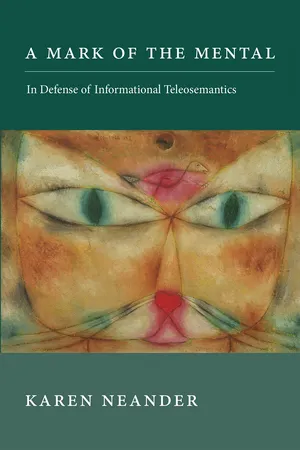
In A Mark of the Mental, Karen Neander considers the representational power of mental states—described by the cognitive scientist Zenon Pylyshyn as the "second hardest puzzle" of philosophy of mind (the first being consciousness). The puzzle at the heart of the book is sometimes called "the problem of mental content," "Brentano's problem," or "the problem of intentionality." Its motivating mystery is how neurobiological states can have semantic properties such as meaning or reference. Neander proposes a naturalistic account for sensory-perceptual (nonconceptual) representations.
Neander draws on insights from state-space semantics (which appeals to relations of second-order similarity between representing and represented domains), causal theories of reference (which claim the reference relation is a causal one), and teleosemantic theories (which claim that semantic norms, at their simplest, depend on functional norms). She proposes and defends an intuitive, theoretically well-motivated but highly controversial thesis: sensory-perceptual systems have the function to produce inner state changes that are the analogs of as well as caused by their referents. Neander shows that the three main elements—functions, causal-information relations, and relations of second-order similarity—complement rather than conflict with each other. After developing an argument for teleosemantics by examining the nature of explanation in the mind and brain sciences, she develops a theory of mental content and defends it against six main content-determinacy challenges to a naturalized semantics.
eBook - ePub
A Mark of the Mental
In Defense of Informational Teleosemantics
- English
- ePUB (mobile friendly)
- Available on iOS & Android
eBook - ePub
A Mark of the Mental
In Defense of Informational Teleosemantics
About this book
Information
Topic
PhilosophySubtopic
Mind & Body in PhilosophyTable of contents
- Cover
- Series page
- Title page
- Copyright page
- Dedication
- Table of Contents
- Acknowledgments
- 1 Thinking about Thought
- 2 Positing Nonconceptual Representations
- 3 Functional Analysis and the Species Design
- 4 The Methodological Argument for Informational Teleosemantics
- 5 Simple Minds
- 6 Response Functions
- 7 The Content-Determinacy Challenges
- 8 Causally Driven Analogs
- 9 Distal and Distant Red Squares
- References
- Index
Trusted by 375,005 students
Access to over 1.5 million titles for a fair monthly price.
Study more efficiently using our study tools.
Frequently asked questions
Yes, you can cancel anytime from the Subscription tab in your account settings on the Perlego website. Your subscription will stay active until the end of your current billing period. Learn how to cancel your subscription
No, books cannot be downloaded as external files, such as PDFs, for use outside of Perlego. However, you can download books within the Perlego app for offline reading on mobile or tablet. Learn how to download books offline
Perlego offers two plans: Essential and Complete
- Essential is ideal for learners and professionals who enjoy exploring a wide range of subjects. Access the Essential Library with 800,000+ trusted titles and best-sellers across business, personal growth, and the humanities. Includes unlimited reading time and Standard Read Aloud voice.
- Complete: Perfect for advanced learners and researchers needing full, unrestricted access. Unlock 1.5M+ books across hundreds of subjects, including academic and specialized titles. The Complete Plan also includes advanced features like Premium Read Aloud and Research Assistant.
We are an online textbook subscription service, where you can get access to an entire online library for less than the price of a single book per month. With over 1.5 million books across 990+ topics, we’ve got you covered! Learn about our mission
Look out for the read-aloud symbol on your next book to see if you can listen to it. The read-aloud tool reads text aloud for you, highlighting the text as it is being read. You can pause it, speed it up and slow it down. Learn more about Read Aloud
Yes! You can use the Perlego app on both iOS and Android devices to read anytime, anywhere — even offline. Perfect for commutes or when you’re on the go.
Please note we cannot support devices running on iOS 13 and Android 7 or earlier. Learn more about using the app
Please note we cannot support devices running on iOS 13 and Android 7 or earlier. Learn more about using the app
Yes, you can access A Mark of the Mental by Karen Neander, Kim Sterelny,Robert A. Wilson in PDF and/or ePUB format, as well as other popular books in Philosophy & Mind & Body in Philosophy. We have over 1.5 million books available in our catalogue for you to explore.