Psychiatry and mental health research is in crisis, with tensions between psychiatry's clinical and research aims and controversies over diagnosis, treatment, and scientific constructs for studying mental disorders. At the center of these controversies is the Diagnostic and Statistical Manual of Mental Disorders (DSM), which—especially after the publication of DSM-5—many have found seriously flawed as a guide for research. This book addresses the crisis and the associated "extraordinary science" (Thomas Kuhn's term for scientific research during a state of crisis) from the perspective of philosophy of science. The goal is to help reconcile the competing claims of science and phenomenology within psychiatry and to offer new insights for the philosophy of science.
The contributors discuss the epistemological origins of the current crisis, the nature of evidence in psychiatric research, and the National Institute for Mental Health's Research Domain Criteria project. They consider particular research practices in psychiatry—computational, personalized, mechanistic, and user-led—and the specific categories of schizophrenia, depressive disorder, and bipolar disorder. Finally, they examine the DSM's dubious practice of pathologizing normality.
Contributors
Richard P. Bentall, John Bickle, Robyn Bluhm, Rachel Cooper, Kelso Cratsley, Owen Flanagan, Michael Frank, George Graham, Ginger A. Hoffman, Harold Kincaid, Aaron Kostko, Edouard Machery, Jeffrey Poland, Claire Pouncey, ?erife Tekin, Peter Zachar
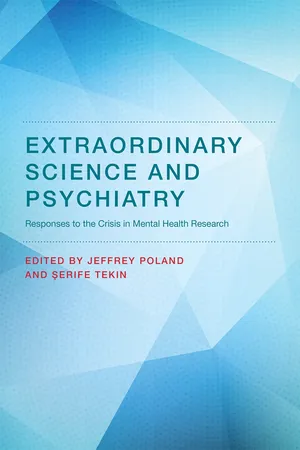
eBook - ePub
Extraordinary Science and Psychiatry
Responses to the Crisis in Mental Health Research
- English
- ePUB (mobile friendly)
- Available on iOS & Android
eBook - ePub
Extraordinary Science and Psychiatry
Responses to the Crisis in Mental Health Research
About this book
Information
Subtopic
Philosophy History & TheoryIndex
PsychologyTable of contents
- Cover
- Series page
- Title page
- Copyright page
- Dedication
- Table of Contents
- Acknowledgments
- 1 Introduction: Psychiatric Research and Extraordinary Science
- 2 Kinds or Tails?
- 3 Evidence-Based Medicine, Biological Psychiatry, and the Role of Science in Medicine
- 4 RDoC’s Metaphysical Assumptions: Problems and Promises
- 5 Psychopathology without Nosology: The Research Domain Criteria Project as Normal Science
- 6 The Promise of Computational Psychiatry
- 7 Personalized Psychiatry and Scientific Causal Explanations: Two Accounts
- 8 The Shift to Mechanistic Explanation and Classification
- 9 Classification, Rating Scales, and Promoting User-Led Research
- 10 Six Myths about Schizophrenia: A Paradigm Well Beyond Its Use-By Date?
- 11 Looking for the Self in Psychiatry: Perils and Promises of Phenomenology–Neuroscience Partnership in Schizophrenia Research
- 12 DSM Applications to Young Children: Are There Really Bipolar and Depressed Two-Year-Olds?
- 13 Truth and Sanity: Positive Illusions, Spiritual Delusions, and Metaphysical Hallucinations
- Contributors
- Index
Trusted by 375,005 students
Access to over 1.5 million titles for a fair monthly price.
Study more efficiently using our study tools.
Frequently asked questions
Yes, you can cancel anytime from the Subscription tab in your account settings on the Perlego website. Your subscription will stay active until the end of your current billing period. Learn how to cancel your subscription
No, books cannot be downloaded as external files, such as PDFs, for use outside of Perlego. However, you can download books within the Perlego app for offline reading on mobile or tablet. Learn how to download books offline
Perlego offers two plans: Essential and Complete
- Essential is ideal for learners and professionals who enjoy exploring a wide range of subjects. Access the Essential Library with 800,000+ trusted titles and best-sellers across business, personal growth, and the humanities. Includes unlimited reading time and Standard Read Aloud voice.
- Complete: Perfect for advanced learners and researchers needing full, unrestricted access. Unlock 1.5M+ books across hundreds of subjects, including academic and specialized titles. The Complete Plan also includes advanced features like Premium Read Aloud and Research Assistant.
We are an online textbook subscription service, where you can get access to an entire online library for less than the price of a single book per month. With over 1.5 million books across 990+ topics, we’ve got you covered! Learn about our mission
Look out for the read-aloud symbol on your next book to see if you can listen to it. The read-aloud tool reads text aloud for you, highlighting the text as it is being read. You can pause it, speed it up and slow it down. Learn more about Read Aloud
Yes! You can use the Perlego app on both iOS and Android devices to read anytime, anywhere — even offline. Perfect for commutes or when you’re on the go.
Please note we cannot support devices running on iOS 13 and Android 7 or earlier. Learn more about using the app
Please note we cannot support devices running on iOS 13 and Android 7 or earlier. Learn more about using the app
Yes, you can access Extraordinary Science and Psychiatry by Jeffrey Poland,Şerife Tekin, Jeffrey Poland,Jennifer Radden in PDF and/or ePUB format, as well as other popular books in Psychology & Philosophy History & Theory. We have over 1.5 million books available in our catalogue for you to explore.