"Myra Strober's Sharing the Work is the memoir of a woman who has learned that 'having it all' is only possible by 'sharing it all,' from finding a partner who values your work as much as you do, to fighting for family-friendly policies. You will learn that finding allies is crucial, blending families after divorce is possible, and that there is neither a good time nor a bad time to have children. Both women and men will find a friend in these pages."
—Gloria Steinem
Myra Strober became a feminist on the Bay Bridge, heading toward San Francisco. It is 1970. She has just been told by the chairman of Berkeley's economics department that she can never get tenure. Driving home afterward, wondering if she got something out of the freezer for her family's dinner, she realizes the truth: she is being denied a regular faculty position because she is a mother. Flooded with anger, she also finds her life's work: to study and fight sexism, in the workplace, in academia, and at home.
Strober's generous memoir captures the spirit of a revolution lived fully, from her Brooklyn childhood (and her shock at age twelve when she's banished to the women's balcony at shul) to her groundbreaking Stanford seminar on women and work. Strober's interest in women and work began when she saw her mother's frustration at the limitations of her position as a secretary. Her consciousness of the unfairness of the usual distribution of household chores came when she unsuccessfully asked her husband for help with housework. Later, when a group of conservative white male professors sputtered at the idea of government-subsidized child care, Strober made the case for its economic benefits.
In the 1970s, the term "sexual harassment" had not yet been coined. Occupational segregation, quantifying the value of work in the home, and the cost of discrimination were new ideas. Strober was a pioneer, helping to create a new academic field and founding institutions to establish it. But she wasn't alone: she benefited from the women's movement, institutional change, and new federal regulations that banned sex discrimination. She continues the work today and invites us to join her.
eBook - ePub
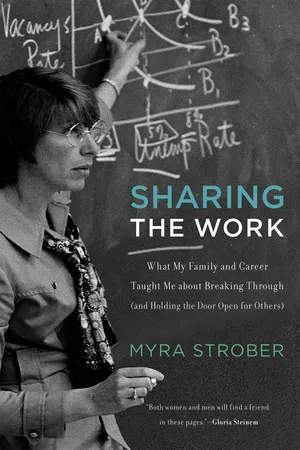
Sharing the Work
What My Family and Career Taught Me about Breaking Through (and Holding the Door Open for Others)
- English
- ePUB (mobile friendly)
- Available on iOS & Android
eBook - ePub
Sharing the Work
What My Family and Career Taught Me about Breaking Through (and Holding the Door Open for Others)
About this book
Information
Subtopic
Social Science BiographiesIndex
Social SciencesTable of contents
- Cover
- BITS page
- Table of Contents
- 1 Sisterhood Is Powerful, 1970–1971
Trusted by 375,005 students
Access to over 1.5 million titles for a fair monthly price.
Study more efficiently using our study tools.
Frequently asked questions
Yes, you can cancel anytime from the Subscription tab in your account settings on the Perlego website. Your subscription will stay active until the end of your current billing period. Learn how to cancel your subscription
No, books cannot be downloaded as external files, such as PDFs, for use outside of Perlego. However, you can download books within the Perlego app for offline reading on mobile or tablet. Learn how to download books offline
Perlego offers two plans: Essential and Complete
- Essential is ideal for learners and professionals who enjoy exploring a wide range of subjects. Access the Essential Library with 800,000+ trusted titles and best-sellers across business, personal growth, and the humanities. Includes unlimited reading time and Standard Read Aloud voice.
- Complete: Perfect for advanced learners and researchers needing full, unrestricted access. Unlock 1.5M+ books across hundreds of subjects, including academic and specialized titles. The Complete Plan also includes advanced features like Premium Read Aloud and Research Assistant.
We are an online textbook subscription service, where you can get access to an entire online library for less than the price of a single book per month. With over 1.5 million books across 990+ topics, we’ve got you covered! Learn about our mission
Look out for the read-aloud symbol on your next book to see if you can listen to it. The read-aloud tool reads text aloud for you, highlighting the text as it is being read. You can pause it, speed it up and slow it down. Learn more about Read Aloud
Yes! You can use the Perlego app on both iOS and Android devices to read anytime, anywhere — even offline. Perfect for commutes or when you’re on the go.
Please note we cannot support devices running on iOS 13 and Android 7 or earlier. Learn more about using the app
Please note we cannot support devices running on iOS 13 and Android 7 or earlier. Learn more about using the app
Yes, you can access Sharing the Work by Myra Strober in PDF and/or ePUB format, as well as other popular books in Social Sciences & Social Science Biographies. We have over 1.5 million books available in our catalogue for you to explore.