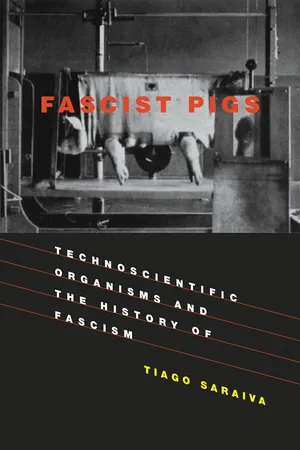
In the fascist regimes of Mussolini's Italy, Salazar's Portugal, and Hitler's Germany, the first mass mobilizations involved wheat engineered to take advantage of chemical fertilizers, potatoes resistant to late blight, and pigs that thrived on national produce. Food independence was an early goal of fascism; indeed, as Tiago Saraiva writes in Fascist Pigs, fascists were obsessed with projects to feed the national body from the national soil. Saraiva shows how such technoscientific organisms as specially bred wheat and pigs became important elements in the institutionalization and expansion of fascist regimes. The pigs, the potatoes, and the wheat embodied fascism. In Nazi Germany, only plants and animals conforming to the new national standards would be allowed to reproduce. Pigs that didn't efficiently convert German-grown potatoes into pork and lard were eliminated.
Saraiva describes national campaigns that intertwined the work of geneticists with new state bureaucracies; discusses fascist empires, considering forced labor on coffee, rubber, and cotton in Ethiopia, Mozambique, and Eastern Europe; and explores fascist genocides, following Karakul sheep from a laboratory in Germany to Eastern Europe, Libya, Ethiopia, and Angola.
Saraiva's highly original account—the first systematic study of the relation between science and fascism—argues that the "back to the land" aspect of fascism should be understood as a modernist experiment involving geneticists and their organisms, mass propaganda, overgrown bureaucracy, and violent colonialism.
eBook - ePub
Fascist Pigs
Technoscientific Organisms and the History of Fascism
- English
- ePUB (mobile friendly)
- Available on iOS & Android
eBook - ePub
Fascist Pigs
Technoscientific Organisms and the History of Fascism
About this book
Information
Subtopic
Fascism & TotalitarianismIndex
HistoryTable of contents
- Cover
- Series page
- Title page
- Copyright page
- Dedication
- Table of Contents
- Acknowledgments
- Introduction
- I Nation
- II Empire
- Conclusion
- Index
- Inside Technology
Trusted by 375,005 students
Access to over 1.5 million titles for a fair monthly price.
Study more efficiently using our study tools.
Frequently asked questions
Yes, you can cancel anytime from the Subscription tab in your account settings on the Perlego website. Your subscription will stay active until the end of your current billing period. Learn how to cancel your subscription
No, books cannot be downloaded as external files, such as PDFs, for use outside of Perlego. However, you can download books within the Perlego app for offline reading on mobile or tablet. Learn how to download books offline
Perlego offers two plans: Essential and Complete
- Essential is ideal for learners and professionals who enjoy exploring a wide range of subjects. Access the Essential Library with 800,000+ trusted titles and best-sellers across business, personal growth, and the humanities. Includes unlimited reading time and Standard Read Aloud voice.
- Complete: Perfect for advanced learners and researchers needing full, unrestricted access. Unlock 1.5M+ books across hundreds of subjects, including academic and specialized titles. The Complete Plan also includes advanced features like Premium Read Aloud and Research Assistant.
We are an online textbook subscription service, where you can get access to an entire online library for less than the price of a single book per month. With over 1.5 million books across 990+ topics, we’ve got you covered! Learn about our mission
Look out for the read-aloud symbol on your next book to see if you can listen to it. The read-aloud tool reads text aloud for you, highlighting the text as it is being read. You can pause it, speed it up and slow it down. Learn more about Read Aloud
Yes! You can use the Perlego app on both iOS and Android devices to read anytime, anywhere — even offline. Perfect for commutes or when you’re on the go.
Please note we cannot support devices running on iOS 13 and Android 7 or earlier. Learn more about using the app
Please note we cannot support devices running on iOS 13 and Android 7 or earlier. Learn more about using the app
Yes, you can access Fascist Pigs by Tiago Saraiva, Edward Jones-Imhotep,Rebecca Slayton,Wiebe E. Bijker in PDF and/or ePUB format, as well as other popular books in History & Fascism & Totalitarianism. We have over 1.5 million books available in our catalogue for you to explore.