Models abound in science, technology, and society (STS) studies and in science, technology, and innovation (STI) studies. They are continually being invented, with one author developing many versions of the same model over time. At the same time, models are regularly criticized. Such is the case with the most influential model in STS-STI: the linear model of innovation.
In this book, Benoît Godin examines the emergence and diffusion of the three most important conceptual models of innovation from the early twentieth century to the late 1980s: stage models, linear models, and holistic models. Godin first traces the history of the models of innovation constructed during this period, considering why these particular models came into being and what use was made of them. He then rethinks and debunks the historical narratives of models developed by theorists of innovation. Godin documents a greater diversity of thinkers and schools than in the conventional account, tracing a genealogy of models beginning with anthropologists, industrialists, and practitioners in the first half of the twentieth century to their later formalization in STS-STI.
Godin suggests that a model is a conceptualization, which could be narrative, or a set of conceptualizations, or a paradigmatic perspective, often in pictorial form and reduced discursively to a simplified representation of reality. Why are so many things called models? Godin claims that model has a rhetorical function. First, a model is a symbol of "scientificity." Second, a model travels easily among scholars and policy makers. Calling a conceptualization or narrative or perspective a model facilitates its propagation.
eBook - ePub
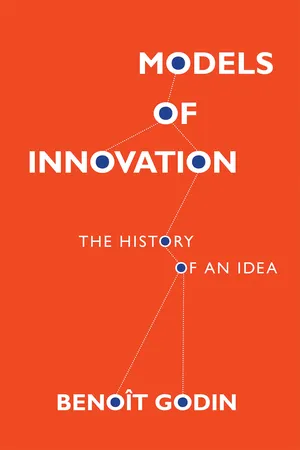
Models of Innovation
The History of an Idea
- English
- ePUB (mobile friendly)
- Available on iOS & Android
eBook - ePub
Models of Innovation
The History of an Idea
About this book
Information
Subtopic
Science HistoryTable of contents
- Cover
- Series page
- Title page
- Copyright page
- Epigraph
- Table of Contents
- Acknowledgments
- Introduction
- I Stage Models
- II Linear Models
- III System Models
- Conclusion
- Appendixes
- References
- Index
- Inside Technology
Trusted by 375,005 students
Access to over 1.5 million titles for a fair monthly price.
Study more efficiently using our study tools.
Frequently asked questions
Yes, you can cancel anytime from the Subscription tab in your account settings on the Perlego website. Your subscription will stay active until the end of your current billing period. Learn how to cancel your subscription
No, books cannot be downloaded as external files, such as PDFs, for use outside of Perlego. However, you can download books within the Perlego app for offline reading on mobile or tablet. Learn how to download books offline
Perlego offers two plans: Essential and Complete
- Essential is ideal for learners and professionals who enjoy exploring a wide range of subjects. Access the Essential Library with 800,000+ trusted titles and best-sellers across business, personal growth, and the humanities. Includes unlimited reading time and Standard Read Aloud voice.
- Complete: Perfect for advanced learners and researchers needing full, unrestricted access. Unlock 1.5M+ books across hundreds of subjects, including academic and specialized titles. The Complete Plan also includes advanced features like Premium Read Aloud and Research Assistant.
We are an online textbook subscription service, where you can get access to an entire online library for less than the price of a single book per month. With over 1.5 million books across 990+ topics, we’ve got you covered! Learn about our mission
Look out for the read-aloud symbol on your next book to see if you can listen to it. The read-aloud tool reads text aloud for you, highlighting the text as it is being read. You can pause it, speed it up and slow it down. Learn more about Read Aloud
Yes! You can use the Perlego app on both iOS and Android devices to read anytime, anywhere — even offline. Perfect for commutes or when you’re on the go.
Please note we cannot support devices running on iOS 13 and Android 7 or earlier. Learn more about using the app
Please note we cannot support devices running on iOS 13 and Android 7 or earlier. Learn more about using the app
Yes, you can access Models of Innovation by Benoît Godin, Edward Jones-Imhotep,Rebecca Slayton,Wiebe E. Bijker in PDF and/or ePUB format, as well as other popular books in Technology & Engineering & Science History. We have over 1.5 million books available in our catalogue for you to explore.