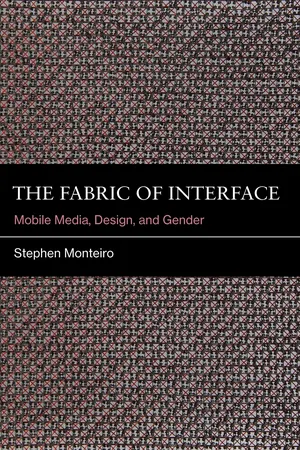
For many of our interactions with digital media, we do not sit at a keyboard but hold a mobile device in our hands. We turn and tilt and stroke and tap, and through these physical interactions with an object we make things: images, links, sites, networks. In The Fabric of Interface, Stephen Monteiro argues that our everyday digital practice has taken on traits common to textile and needlecraft culture. Our smart phones and tablets use some of the same skills—manual dexterity, pattern making, and linking—required by the handloom, the needlepoint hoop, and the lap-sized quilting frame. Monteiro goes on to argue that the capacity of textile metaphors to describe computing (weaving code, threaded discussions, zipped files, software patches, switch fabrics) represents deeper connections between digital communication and what has been called "homecraft" or "women's work."
Connecting networked media to practices that seem alien to media technologies, Monteiro identifies handicraft and textile techniques in the production of software and hardware, and cites the punched cards that were read by a loom's rods as a primitive form of computer memory; examines textual and visual discourses that position the digital image as a malleable fabric across its production, access, and use; compares the digital labor of liking, linking, and tagging to such earlier forms of collective production as quilting bees and piecework; and describes how the convergence of intimacy and handiwork at the screen interface, combined with needlecraft aesthetics, genders networked culture and activities in unexpected ways.
- English
- ePUB (mobile friendly)
- Available on iOS & Android
eBook - ePub
About this book
Information
Subtopic
Design GeneralIndex
Social SciencesTable of contents
- Cover
- Title page
- Copyright page
- Dedication
- Table of Contents
- Acknowledgments
- Introduction
- 1 Woven Memory
- 2 Image Fabric
- 3 Piecework
- 4 Domestic Disturbances
- Index
Trusted by 375,005 students
Access to over 1.5 million titles for a fair monthly price.
Study more efficiently using our study tools.
Frequently asked questions
Yes, you can cancel anytime from the Subscription tab in your account settings on the Perlego website. Your subscription will stay active until the end of your current billing period. Learn how to cancel your subscription
No, books cannot be downloaded as external files, such as PDFs, for use outside of Perlego. However, you can download books within the Perlego app for offline reading on mobile or tablet. Learn how to download books offline
Perlego offers two plans: Essential and Complete
- Essential is ideal for learners and professionals who enjoy exploring a wide range of subjects. Access the Essential Library with 800,000+ trusted titles and best-sellers across business, personal growth, and the humanities. Includes unlimited reading time and Standard Read Aloud voice.
- Complete: Perfect for advanced learners and researchers needing full, unrestricted access. Unlock 1.5M+ books across hundreds of subjects, including academic and specialized titles. The Complete Plan also includes advanced features like Premium Read Aloud and Research Assistant.
We are an online textbook subscription service, where you can get access to an entire online library for less than the price of a single book per month. With over 1.5 million books across 990+ topics, we’ve got you covered! Learn about our mission
Look out for the read-aloud symbol on your next book to see if you can listen to it. The read-aloud tool reads text aloud for you, highlighting the text as it is being read. You can pause it, speed it up and slow it down. Learn more about Read Aloud
Yes! You can use the Perlego app on both iOS and Android devices to read anytime, anywhere — even offline. Perfect for commutes or when you’re on the go.
Please note we cannot support devices running on iOS 13 and Android 7 or earlier. Learn more about using the app
Please note we cannot support devices running on iOS 13 and Android 7 or earlier. Learn more about using the app
Yes, you can access The Fabric of Interface by Stephen Monteiro in PDF and/or ePUB format, as well as other popular books in Social Sciences & Design General. We have over 1.5 million books available in our catalogue for you to explore.