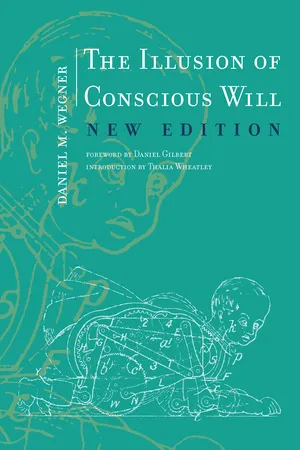
Do we consciously cause our actions, or do they happen to us? Philosophers, psychologists, neuroscientists, theologians, and lawyers have long debated the existence of free will versus determinism. With the publication of The Illusion of Conscious Will in 2002, Daniel Wegner proposed an innovative and provocative answer: the feeling of conscious will is created by the mind and brain; it helps us to appreciate and remember our authorship of the things our minds and bodies do. Yes, we feel that we consciously will our actions, Wegner says, but at the same time, our actions happen to us. Although conscious will is an illusion ("the most compelling illusion"), it serves as a guide to understanding ourselves and to developing a sense of responsibility and morality. Wegner was unable to undertake a second edition of the book before his death in 2013; this new edition adds a foreword by Wegner's friend, the prominent psychologist Daniel Gilbert, and an introduction by Wegner's colleague Thalia Wheatley.
Approaching conscious will as a topic of psychological study, Wegner examines cases both when people feel that they are willing an act that they are not doing and when they are not willing an act that they in fact are doing in such phenomena as hypnosis, Ouija board spelling, and dissociative identity disorder.
Wegner's argument was immediately controversial (called "unwarranted impertinence" by one scholar) but also compelling. Engagingly written, with wit and clarity, The Illusion of Conscious Will was, as Daniel Gilbert writes in the foreword to this edition, Wegner's "magnum opus."
- English
- ePUB (mobile friendly)
- Available on iOS & Android
eBook - ePub
The Illusion of Conscious Will
About this book
Information
Topic
PhilosophyTable of contents
- Cover
- Title page
- Copyright page
- Dedication
- Table of Contents
- Foreword
- Preface to the New Edition
- Preface
- 1 The Illusion
- 2 Brain and Body
- 3 The Experience of Will
- 4 An Analysis of Automatism
- 5 Protecting the Illusion
- 6 Action Projection
- 7 Virtual Agency
- 8 Hypnosis and Will
- 9 The Mind’s Compass
- References
- Author Index
- Subject Index
Trusted by 375,005 students
Access to over 1.5 million titles for a fair monthly price.
Study more efficiently using our study tools.
Frequently asked questions
Yes, you can cancel anytime from the Subscription tab in your account settings on the Perlego website. Your subscription will stay active until the end of your current billing period. Learn how to cancel your subscription
No, books cannot be downloaded as external files, such as PDFs, for use outside of Perlego. However, you can download books within the Perlego app for offline reading on mobile or tablet. Learn how to download books offline
Perlego offers two plans: Essential and Complete
- Essential is ideal for learners and professionals who enjoy exploring a wide range of subjects. Access the Essential Library with 800,000+ trusted titles and best-sellers across business, personal growth, and the humanities. Includes unlimited reading time and Standard Read Aloud voice.
- Complete: Perfect for advanced learners and researchers needing full, unrestricted access. Unlock 1.5M+ books across hundreds of subjects, including academic and specialized titles. The Complete Plan also includes advanced features like Premium Read Aloud and Research Assistant.
We are an online textbook subscription service, where you can get access to an entire online library for less than the price of a single book per month. With over 1.5 million books across 990+ topics, we’ve got you covered! Learn about our mission
Look out for the read-aloud symbol on your next book to see if you can listen to it. The read-aloud tool reads text aloud for you, highlighting the text as it is being read. You can pause it, speed it up and slow it down. Learn more about Read Aloud
Yes! You can use the Perlego app on both iOS and Android devices to read anytime, anywhere — even offline. Perfect for commutes or when you’re on the go.
Please note we cannot support devices running on iOS 13 and Android 7 or earlier. Learn more about using the app
Please note we cannot support devices running on iOS 13 and Android 7 or earlier. Learn more about using the app
Yes, you can access The Illusion of Conscious Will by Daniel M. Wegner in PDF and/or ePUB format, as well as other popular books in Philosophy & Free Will & Determinism in Philosophy. We have over 1.5 million books available in our catalogue for you to explore.