Waste is material information. Landfills are detailed records of everyday consumption and behavior; much of what we know about the distant past we know from discarded objects unearthed by archaeologists and interpreted by historians. And yet the systems and infrastructures that process our waste often remain opaque. In this book, Dietmar Offenhuber examines waste from the perspective of information, considering emerging practices and technologies for making waste systems legible and how the resulting datasets and visualizations shape infrastructure governance. He does so by looking at three waste tracking and participatory sensing projects in Seattle, São Paulo, and Boston.
Offenhuber expands the notion of urban legibility—the idea that the city can be read like a text—to introduce the concept of infrastructure legibility. He argues that infrastructure governance is enacted through representations of the infrastructural system, and that these representations stem from the different stakeholders' interests, which drive their efforts to make the system legible. The Trash Track project in Seattle used sensor technology to map discarded items through the waste and recycling systems; the Forager project looked at the informal organization processes of waste pickers working for Brazilian recycling cooperatives; and mobile systems designed by the city of Boston allowed residents to report such infrastructure failures as potholes and garbage spills. Through these case studies, Offenhuber outlines an emerging paradigm of infrastructure governance based on a
complex negotiation among users, technology, and the city.
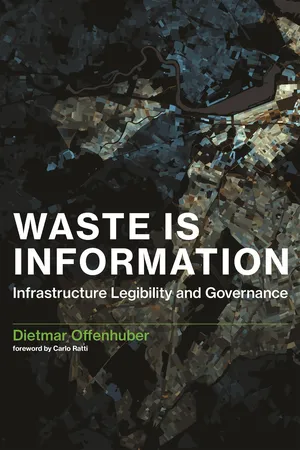
eBook - ePub
Waste Is Information
Infrastructure Legibility and Governance
- English
- ePUB (mobile friendly)
- Available on iOS & Android
eBook - ePub
Waste Is Information
Infrastructure Legibility and Governance
About this book
Information
Table of contents
- Cover
- Series page
- Title page
- Copyright page
- Table of Contents
- Foreword
- Preface: The Paper Police
- Introduction: Waste Is Information
- I Legibility
- II Informality
- III Participation
- Conclusion: A Case for Accountability-Oriented Design
- References
- Acknowledgments
- Index
Trusted by 375,005 students
Access to over 1.5 million titles for a fair monthly price.
Study more efficiently using our study tools.
Frequently asked questions
Yes, you can cancel anytime from the Subscription tab in your account settings on the Perlego website. Your subscription will stay active until the end of your current billing period. Learn how to cancel your subscription
No, books cannot be downloaded as external files, such as PDFs, for use outside of Perlego. However, you can download books within the Perlego app for offline reading on mobile or tablet. Learn how to download books offline
Perlego offers two plans: Essential and Complete
- Essential is ideal for learners and professionals who enjoy exploring a wide range of subjects. Access the Essential Library with 800,000+ trusted titles and best-sellers across business, personal growth, and the humanities. Includes unlimited reading time and Standard Read Aloud voice.
- Complete: Perfect for advanced learners and researchers needing full, unrestricted access. Unlock 1.5M+ books across hundreds of subjects, including academic and specialized titles. The Complete Plan also includes advanced features like Premium Read Aloud and Research Assistant.
We are an online textbook subscription service, where you can get access to an entire online library for less than the price of a single book per month. With over 1.5 million books across 990+ topics, we’ve got you covered! Learn about our mission
Look out for the read-aloud symbol on your next book to see if you can listen to it. The read-aloud tool reads text aloud for you, highlighting the text as it is being read. You can pause it, speed it up and slow it down. Learn more about Read Aloud
Yes! You can use the Perlego app on both iOS and Android devices to read anytime, anywhere — even offline. Perfect for commutes or when you’re on the go.
Please note we cannot support devices running on iOS 13 and Android 7 or earlier. Learn more about using the app
Please note we cannot support devices running on iOS 13 and Android 7 or earlier. Learn more about using the app
Yes, you can access Waste Is Information by Dietmar Offenhuber, Janet Vertesi,Paul N. Edwards in PDF and/or ePUB format, as well as other popular books in Technology & Engineering & City Planning & Urban Development. We have over 1.5 million books available in our catalogue for you to explore.