The message from educators, the tech community, and even politicians is clear: everyone should learn to code. To emphasize the universality and importance of computer programming, promoters of coding for everyone often invoke the concept of "literacy," drawing parallels between reading and writing code and reading and writing text. In this book, Annette Vee examines the coding-as-literacy analogy and argues that it can be an apt rhetorical frame. The theoretical tools of literacy help us understand programming beyond a technical level, and in its historical, social, and conceptual contexts. Viewing programming from the perspective of literacy and literacy from the perspective of programming, she argues, shifts our understandings of both. Computer programming becomes part of an array of communication skills important in everyday life, and literacy, augmented by programming, becomes more capacious.
Vee examines the ways that programming is linked with literacy in coding literacy campaigns, considering the ideologies that accompany this coupling, and she looks at how both writing and programming encode and distribute information. She explores historical parallels between writing and programming, using the evolution of mass textual literacy to shed light on the trajectory of code from military and government infrastructure to large-scale businesses to personal use. Writing and coding were institutionalized, domesticated, and then established as a basis for literacy. Just as societies demonstrated a "literate mentality" regardless of the literate status of individuals, Vee argues, a "computational mentality" is now emerging even though coding is still a specialized skill.
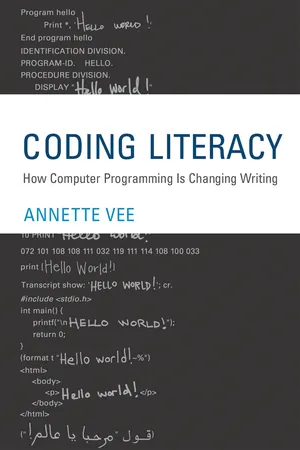
eBook - ePub
Coding Literacy
How Computer Programming Is Changing Writing
- English
- ePUB (mobile friendly)
- Available on iOS & Android
eBook - ePub
Coding Literacy
How Computer Programming Is Changing Writing
About this book
Information
Subtopic
ProgrammingIndex
Computer ScienceTable of contents
- Cover
- Series page
- Title page
- Copyright page
- Table of Contents
- Series Foreword
- Acknowledgments
- Introduction: Computer Programming as Literacy
- 1 Coding for Everyone and the Legacy of Mass Literacy
- 2 Sociomaterialities of Programming and Writing
- 3 Material Infrastructures of Writing and Programming
- 4 Literacy for Everyday Life
- Conclusion: Promoting Coding Literacy—Lessons from Reading and Writing
- Bibliography
- Index
Trusted by 375,005 students
Access to over 1.5 million titles for a fair monthly price.
Study more efficiently using our study tools.
Frequently asked questions
Yes, you can cancel anytime from the Subscription tab in your account settings on the Perlego website. Your subscription will stay active until the end of your current billing period. Learn how to cancel your subscription
No, books cannot be downloaded as external files, such as PDFs, for use outside of Perlego. However, you can download books within the Perlego app for offline reading on mobile or tablet. Learn how to download books offline
Perlego offers two plans: Essential and Complete
- Essential is ideal for learners and professionals who enjoy exploring a wide range of subjects. Access the Essential Library with 800,000+ trusted titles and best-sellers across business, personal growth, and the humanities. Includes unlimited reading time and Standard Read Aloud voice.
- Complete: Perfect for advanced learners and researchers needing full, unrestricted access. Unlock 1.5M+ books across hundreds of subjects, including academic and specialized titles. The Complete Plan also includes advanced features like Premium Read Aloud and Research Assistant.
We are an online textbook subscription service, where you can get access to an entire online library for less than the price of a single book per month. With over 1.5 million books across 990+ topics, we’ve got you covered! Learn about our mission
Look out for the read-aloud symbol on your next book to see if you can listen to it. The read-aloud tool reads text aloud for you, highlighting the text as it is being read. You can pause it, speed it up and slow it down. Learn more about Read Aloud
Yes! You can use the Perlego app on both iOS and Android devices to read anytime, anywhere — even offline. Perfect for commutes or when you’re on the go.
Please note we cannot support devices running on iOS 13 and Android 7 or earlier. Learn more about using the app
Please note we cannot support devices running on iOS 13 and Android 7 or earlier. Learn more about using the app
Yes, you can access Coding Literacy by Annette Vee, Jichen Zhu,Noah Wardrip-Fruin,Wendy Hui Kyong Chun,Winnie Soon in PDF and/or ePUB format, as well as other popular books in Computer Science & Programming. We have over 1.5 million books available in our catalogue for you to explore.