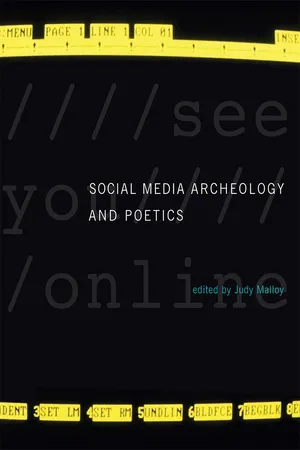
Focusing on early social media in the arts and humanities and on the core role of creative computer scientists, artists, and scholars in shaping the pre-Web social media landscape, Social Media Archeology and Poetics documents social media lineage, beginning in the 1970s with collaborative ARPANET research, Community Memory, PLATO, Minitel, and ARTEX and continuing into the 1980s and beyond with the Electronic Café, Art Com Electronic Network, Arts Wire, The THING, and many more.
With first person accounts from pioneers in the field, as well as papers by artists, scholars, and curators, Social Media Archeology and Poetics documents how these platforms were vital components of early social networking and important in the development of new media and electronic literature. It describes platforms that allowed artists and musicians to share and publish their work, community networking diversity, and the creation of footholds for the arts and humanities online. And it invites comparisons of social media in the past and present, asking: What can we learn from early social media that will inspire us to envision a greater cultural presence on contemporary social media?
Contributors
Madeline Gonzalez Allen, James Blustein, Hank Bull, Annick Bureaud, J. R. Carpenter, Paul E. Ceruzzi, Anna Couey, Amanda McDonald Crowley, Steve Dietz, Judith Donath, Steven Durland, Lee Felsenstein, Susanne Gerber, Ann-Barbara Graff, Dene Grigar, Stacy Horn, Antoinette LaFarge, Deena Larsen, Gary O. Larson, Alan Liu, Geert Lovink, Richard Lowenberg, Judy Malloy, Scott McPhee, Julianne Nyhan, Howard Rheingold, Randy Ross, Wolfgang Staehle, Fred Truck, Rob Wittig, David R. Woolley
- English
- ePUB (mobile friendly)
- Available on iOS & Android
eBook - ePub
Social Media Archeology and Poetics
About this book
Information
Subtopic
Digital MarketingTable of contents
- Cover
- Series page
- Title page
- Copyright page
- Dedication
- Table of Contents
- Series Foreword
- Acknowledgments
- I Introductions
- II “Opening the Door to Cyberspace”
- III “See you online!”
- IV Networking the Humanities
- V Community Networking
- VI Social Media Poetics
- VII Responses
- About the Authors
- Index
Trusted by 375,005 students
Access to over 1.5 million titles for a fair monthly price.
Study more efficiently using our study tools.
Frequently asked questions
Yes, you can cancel anytime from the Subscription tab in your account settings on the Perlego website. Your subscription will stay active until the end of your current billing period. Learn how to cancel your subscription
No, books cannot be downloaded as external files, such as PDFs, for use outside of Perlego. However, you can download books within the Perlego app for offline reading on mobile or tablet. Learn how to download books offline
Perlego offers two plans: Essential and Complete
- Essential is ideal for learners and professionals who enjoy exploring a wide range of subjects. Access the Essential Library with 800,000+ trusted titles and best-sellers across business, personal growth, and the humanities. Includes unlimited reading time and Standard Read Aloud voice.
- Complete: Perfect for advanced learners and researchers needing full, unrestricted access. Unlock 1.5M+ books across hundreds of subjects, including academic and specialized titles. The Complete Plan also includes advanced features like Premium Read Aloud and Research Assistant.
We are an online textbook subscription service, where you can get access to an entire online library for less than the price of a single book per month. With over 1.5 million books across 990+ topics, we’ve got you covered! Learn about our mission
Look out for the read-aloud symbol on your next book to see if you can listen to it. The read-aloud tool reads text aloud for you, highlighting the text as it is being read. You can pause it, speed it up and slow it down. Learn more about Read Aloud
Yes! You can use the Perlego app on both iOS and Android devices to read anytime, anywhere — even offline. Perfect for commutes or when you’re on the go.
Please note we cannot support devices running on iOS 13 and Android 7 or earlier. Learn more about using the app
Please note we cannot support devices running on iOS 13 and Android 7 or earlier. Learn more about using the app
Yes, you can access Social Media Archeology and Poetics by Judy Malloy, Sean Cubitt in PDF and/or ePUB format, as well as other popular books in Technology & Engineering & Digital Marketing. We have over 1.5 million books available in our catalogue for you to explore.