Many emerging nations, particularly those least developed, lack basic critical infrastructural services—affordable energy, clean drinking water, dependable sanitation, and effective public transportation, along with reliable food systems. Many of these countries cannot afford the complex and resource-intensive systems based on Western, single-sector, industrialized models. In this book, Hillary Brown and Byron Stigge propose an alternate model for planning and designing infrastructural services in the emerging market context. This new model is holistic and integrated, resilient and sustainable, economical and equitable, creating an infrastructural ecology that is more analogous to the functioning of natural ecosystems.
Brown and Stigge identify five strategic infrastructure objectives and illustrate each with examples of successful projects from across the developing world. Each chapter also highlights exemplary preindustrial systems, demonstrating the long history of resilient, sustainable infrastructure. The case studies describe the use of single solutions to solve multiple problems, creating hybridized and reciprocal systems; "soft path" models for water management, including water reuse and nutrient recovery; post carbon infrastructures for power, heat, and transportation such as rural microhydro and solar-powered rickshaws; climate adaptation systems, including a multi-purpose tunnel and a "floating city"; and the need for community-based, equitable, and culturally appropriate projects.
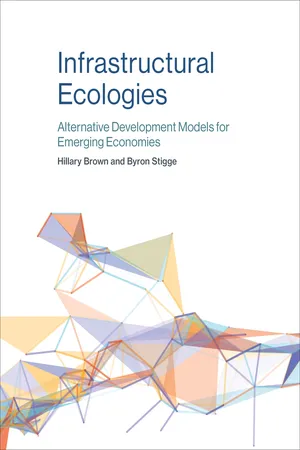
eBook - ePub
Infrastructural Ecologies
Alternative Development Models for Emerging Economies
- English
- ePUB (mobile friendly)
- Available on iOS & Android
eBook - ePub
Infrastructural Ecologies
Alternative Development Models for Emerging Economies
About this book
Information
Subtopic
Urban Planning & LandscapingIndex
Biological SciencesTable of contents
- Cover
- Title Page
- Copyright Page
- Table of Contents
- Acknowledgments
- 1. Introduction: Closing the Infrastructure Gap
- 2. Solving for Pattern: From Interconnected to Symbiotic Systems
- 3. The Soft Path: Aligning Water Infrastructure with Natural Systems
- 4. Post-Carbon Infrastructure: Power, Heat, and Transport
- 5. Climate-Adaptive Infrastructure: Responding to Changing Conditions
- 6. Infrastructural Coproduction: Inclusionary and Participatory Development
- 7. Implementing Infrastructural Ecologies: Improving the Odds
- 8. Putting the Five Objectives into Practice
- Summary of Case Study Infrastructural Ecologies
- Acronyms
- Glossary
- Recommended Readings
- Index
Trusted by 375,005 students
Access to over 1.5 million titles for a fair monthly price.
Study more efficiently using our study tools.
Frequently asked questions
Yes, you can cancel anytime from the Subscription tab in your account settings on the Perlego website. Your subscription will stay active until the end of your current billing period. Learn how to cancel your subscription
No, books cannot be downloaded as external files, such as PDFs, for use outside of Perlego. However, you can download books within the Perlego app for offline reading on mobile or tablet. Learn how to download books offline
Perlego offers two plans: Essential and Complete
- Essential is ideal for learners and professionals who enjoy exploring a wide range of subjects. Access the Essential Library with 800,000+ trusted titles and best-sellers across business, personal growth, and the humanities. Includes unlimited reading time and Standard Read Aloud voice.
- Complete: Perfect for advanced learners and researchers needing full, unrestricted access. Unlock 1.5M+ books across hundreds of subjects, including academic and specialized titles. The Complete Plan also includes advanced features like Premium Read Aloud and Research Assistant.
We are an online textbook subscription service, where you can get access to an entire online library for less than the price of a single book per month. With over 1.5 million books across 990+ topics, we’ve got you covered! Learn about our mission
Look out for the read-aloud symbol on your next book to see if you can listen to it. The read-aloud tool reads text aloud for you, highlighting the text as it is being read. You can pause it, speed it up and slow it down. Learn more about Read Aloud
Yes! You can use the Perlego app on both iOS and Android devices to read anytime, anywhere — even offline. Perfect for commutes or when you’re on the go.
Please note we cannot support devices running on iOS 13 and Android 7 or earlier. Learn more about using the app
Please note we cannot support devices running on iOS 13 and Android 7 or earlier. Learn more about using the app
Yes, you can access Infrastructural Ecologies by Hillary Brown,Byron Stigge in PDF and/or ePUB format, as well as other popular books in Biological Sciences & Urban Planning & Landscaping. We have over 1.5 million books available in our catalogue for you to explore.