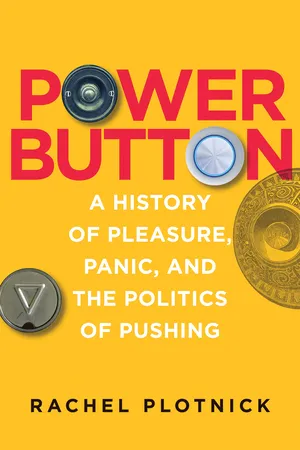
Push a button and turn on the television; tap a button and get a ride; click a button and "like" something. The touch of a finger can set an appliance, a car, or a system in motion, even if the user doesn't understand the underlying mechanisms or algorithms. How did buttons become so ubiquitous? Why do people love them, loathe them, and fear them? In Power Button, Rachel Plotnick traces the origins of today's push-button society by examining how buttons have been made, distributed, used, rejected, and refashioned throughout history. Focusing on the period between 1880 and 1925, when "technologies of the hand" proliferated (including typewriters, telegraphs, and fingerprinting), Plotnick describes the ways that button pushing became a means for digital command, which promised effortless, discreet, and fool-proof control. Emphasizing the doubly digital nature of button pushing—as an act of the finger and a binary activity (on/off, up/down)—Plotnick suggests that the tenets of precomputational digital command anticipate contemporary ideas of computer users.
Plotnick discusses the uses of early push buttons to call servants, and the growing tensions between those who work with their hands and those who command with their fingers; automation as "automagic," enabling command at a distance; instant gratification, and the victory of light over darkness; and early twentieth-century imaginings of a future push-button culture. Push buttons, Plotnick tells us, have demonstrated remarkable staying power, despite efforts to cast button pushers as lazy, privileged, and even dangerous.
- English
- ePUB (mobile friendly)
- Available on iOS & Android
eBook - ePub
About this book
Information
Subtopic
North American HistoryTable of contents
- Cover
- Title page
- Copyright page
- Table of Contents
- Acknowledgments
- Introduction
- I You Rang?
- II Automagically
- III Imagining Digital Command
- Further Reading
- References
- Index
Trusted by 375,005 students
Access to over 1.5 million titles for a fair monthly price.
Study more efficiently using our study tools.
Frequently asked questions
Yes, you can cancel anytime from the Subscription tab in your account settings on the Perlego website. Your subscription will stay active until the end of your current billing period. Learn how to cancel your subscription
No, books cannot be downloaded as external files, such as PDFs, for use outside of Perlego. However, you can download books within the Perlego app for offline reading on mobile or tablet. Learn how to download books offline
Perlego offers two plans: Essential and Complete
- Essential is ideal for learners and professionals who enjoy exploring a wide range of subjects. Access the Essential Library with 800,000+ trusted titles and best-sellers across business, personal growth, and the humanities. Includes unlimited reading time and Standard Read Aloud voice.
- Complete: Perfect for advanced learners and researchers needing full, unrestricted access. Unlock 1.5M+ books across hundreds of subjects, including academic and specialized titles. The Complete Plan also includes advanced features like Premium Read Aloud and Research Assistant.
We are an online textbook subscription service, where you can get access to an entire online library for less than the price of a single book per month. With over 1.5 million books across 990+ topics, we’ve got you covered! Learn about our mission
Look out for the read-aloud symbol on your next book to see if you can listen to it. The read-aloud tool reads text aloud for you, highlighting the text as it is being read. You can pause it, speed it up and slow it down. Learn more about Read Aloud
Yes! You can use the Perlego app on both iOS and Android devices to read anytime, anywhere — even offline. Perfect for commutes or when you’re on the go.
Please note we cannot support devices running on iOS 13 and Android 7 or earlier. Learn more about using the app
Please note we cannot support devices running on iOS 13 and Android 7 or earlier. Learn more about using the app
Yes, you can access Power Button by Rachel Plotnick in PDF and/or ePUB format, as well as other popular books in Technology & Engineering & North American History. We have over 1.5 million books available in our catalogue for you to explore.