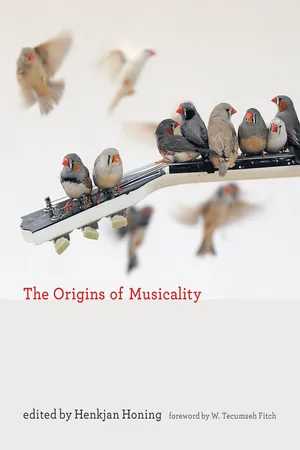
Research shows that all humans have a predisposition for music, just as they do for language. All of us can perceive and enjoy music, even if we can't carry a tune and consider ourselves "unmusical." This volume offers interdisciplinary perspectives on the capacity to perceive, appreciate, and make music. Scholars from biology, musicology, neurology, genetics, computer science, anthropology, psychology, and other fields consider what music is for and why every human culture has it; whether musicality is a uniquely human capacity; and what biological and cognitive mechanisms underlie it.
Contributors outline a research program in musicality, and discuss issues in studying the evolution of music; consider principles, constraints, and theories of origins; review musicality from cross-cultural, cross-species, and cross-domain perspectives; discuss the computational modeling of animal song and creativity; and offer a historical context for the study of musicality. The volume aims to identify the basic neurocognitive mechanisms that constitute musicality (and effective ways to study these in human and nonhuman animals) and to develop a method for analyzing musical phenotypes that point to the biological basis of musicality.
Contributors
Jorge L. Armony, Judith Becker, Simon E. Fisher, W. Tecumseh Fitch, Bruno Gingras, Jessica Grahn, Yuko Hattori, Marisa Hoeschele, Henkjan Honing, David Huron, Dieuwke Hupkes, Yukiko Kikuchi, Julia Kursell, Marie-Élaine Lagrois, Hugo Merchant, Björn Merker, Iain Morley, Aniruddh D. Patel, Isabelle Peretz, Martin Rohrmeier, Constance Scharff, Carel ten Cate, Laurel J. Trainor, Sandra E. Trehub, Peter Tyack, Dominique Vuvan, Geraint Wiggins, Willem Zuidema
- English
- ePUB (mobile friendly)
- Available on iOS & Android
eBook - ePub
The Origins of Musicality
About this book
Information
Subtopic
Cognitive Psychology & CognitionIndex
Biological SciencesTable of contents
- Cover
- Title page
- Copyright page
- Table of Contents
- Foreword
- Preface
- I Introduction
- II Origins, Principles, and Constraints
- III Cross-Cultural, Cross-Species, and Cross-Domain Studies
- IV Structure, Affect, and History
- Contributors
- Index
Trusted by 375,005 students
Access to over 1.5 million titles for a fair monthly price.
Study more efficiently using our study tools.
Frequently asked questions
Yes, you can cancel anytime from the Subscription tab in your account settings on the Perlego website. Your subscription will stay active until the end of your current billing period. Learn how to cancel your subscription
No, books cannot be downloaded as external files, such as PDFs, for use outside of Perlego. However, you can download books within the Perlego app for offline reading on mobile or tablet. Learn how to download books offline
Perlego offers two plans: Essential and Complete
- Essential is ideal for learners and professionals who enjoy exploring a wide range of subjects. Access the Essential Library with 800,000+ trusted titles and best-sellers across business, personal growth, and the humanities. Includes unlimited reading time and Standard Read Aloud voice.
- Complete: Perfect for advanced learners and researchers needing full, unrestricted access. Unlock 1.5M+ books across hundreds of subjects, including academic and specialized titles. The Complete Plan also includes advanced features like Premium Read Aloud and Research Assistant.
We are an online textbook subscription service, where you can get access to an entire online library for less than the price of a single book per month. With over 1.5 million books across 990+ topics, we’ve got you covered! Learn about our mission
Look out for the read-aloud symbol on your next book to see if you can listen to it. The read-aloud tool reads text aloud for you, highlighting the text as it is being read. You can pause it, speed it up and slow it down. Learn more about Read Aloud
Yes! You can use the Perlego app on both iOS and Android devices to read anytime, anywhere — even offline. Perfect for commutes or when you’re on the go.
Please note we cannot support devices running on iOS 13 and Android 7 or earlier. Learn more about using the app
Please note we cannot support devices running on iOS 13 and Android 7 or earlier. Learn more about using the app
Yes, you can access The Origins of Musicality by Henkjan Honing in PDF and/or ePUB format, as well as other popular books in Biological Sciences & Cognitive Psychology & Cognition. We have over 1.5 million books available in our catalogue for you to explore.