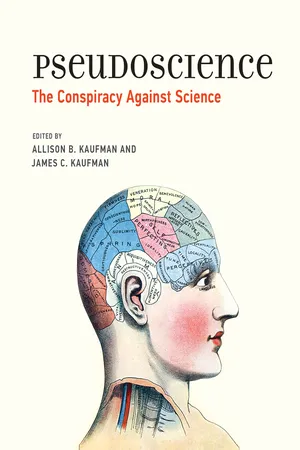
In a post-truth, fake news world, we are particularly susceptible to the claims of pseudoscience. When emotions and opinions are more widely disseminated than scientific findings, and self-proclaimed experts get their expertise from Google, how can the average person distinguish real science from fake? This book examines pseudoscience from a variety of perspectives, through case studies, analysis, and personal accounts that show how to recognize pseudoscience, why it is so widely accepted, and how to advocate for real science.
Contributors examine the basics of pseudoscience, including issues of cognitive bias; the costs of pseudoscience, with accounts of naturopathy and logical fallacies in the anti-vaccination movement; perceptions of scientific soundness; the mainstream presence of "integrative medicine," hypnosis, and parapsychology; and the use of case studies and new media in science advocacy.
Contributors
David Ball, Paul Joseph Barnett, Jeffrey Beall, Mark Benisz, Fernando Blanco, Ron Dumont, Stacy Ellenberg, Kevin M. Folta, Christopher French, Ashwin Gautam, Dennis M. Gorman, David H. Gorski, David K. Hecht, Britt Marie Hermes, Clyde F. Herreid, Jonathan Howard, Seth C. Kalichman, Leif Edward Ottesen Kennair, Arnold Kozak, Scott O. Lilienfeld, Emilio Lobato, Steven Lynn, Adam Marcus, Helena Matute, Ivan Oransky, Chad Orzel, Dorit Reiss, Ellen Beate Hansen Sandseter, Kavin Senapathy, Dean Keith Simonton, Indre Viskontas, John O. Willis, Corrine Zimmerman
- English
- ePUB (mobile friendly)
- Available on iOS & Android
eBook - ePub
About this book
Information
Topic
EducationSubtopic
Teaching Science & TechnologyTable of contents
- Cover
- Title Page
- Copyright Page
- Dedication
- Table of Contents
- Foreword: Navigating a Post-Truth World: Ten Enduring Lessons from the Study of Pseudoscience
- Acknowledgments
- Introduction: Pseudoscience: What It Costs and Efforts to Fight It
- I. The Basics of Pseudoscience
- II. What Pseudoscience Costs Society
- III. Scientific (or Pseudoscientific) Soundness
- IV. Pseudoscience in the Mainstream
- V. Science Activism: How People Think about Pseudoscience
- VI. Conclusion
- Contributor List
- Index
Trusted by 375,005 students
Access to over 1.5 million titles for a fair monthly price.
Study more efficiently using our study tools.
Frequently asked questions
Yes, you can cancel anytime from the Subscription tab in your account settings on the Perlego website. Your subscription will stay active until the end of your current billing period. Learn how to cancel your subscription
No, books cannot be downloaded as external files, such as PDFs, for use outside of Perlego. However, you can download books within the Perlego app for offline reading on mobile or tablet. Learn how to download books offline
Perlego offers two plans: Essential and Complete
- Essential is ideal for learners and professionals who enjoy exploring a wide range of subjects. Access the Essential Library with 800,000+ trusted titles and best-sellers across business, personal growth, and the humanities. Includes unlimited reading time and Standard Read Aloud voice.
- Complete: Perfect for advanced learners and researchers needing full, unrestricted access. Unlock 1.5M+ books across hundreds of subjects, including academic and specialized titles. The Complete Plan also includes advanced features like Premium Read Aloud and Research Assistant.
We are an online textbook subscription service, where you can get access to an entire online library for less than the price of a single book per month. With over 1.5 million books across 990+ topics, we’ve got you covered! Learn about our mission
Look out for the read-aloud symbol on your next book to see if you can listen to it. The read-aloud tool reads text aloud for you, highlighting the text as it is being read. You can pause it, speed it up and slow it down. Learn more about Read Aloud
Yes! You can use the Perlego app on both iOS and Android devices to read anytime, anywhere — even offline. Perfect for commutes or when you’re on the go.
Please note we cannot support devices running on iOS 13 and Android 7 or earlier. Learn more about using the app
Please note we cannot support devices running on iOS 13 and Android 7 or earlier. Learn more about using the app
Yes, you can access Pseudoscience by Allison B. Kaufman,James C. Kaufman in PDF and/or ePUB format, as well as other popular books in Education & Teaching Science & Technology. We have over 1.5 million books available in our catalogue for you to explore.