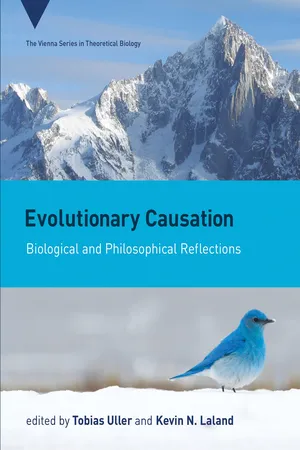
Most scientific explanations are causal. This is certainly the case in evolutionary biology, which seeks to explain the diversity of life and the adaptive fit between organisms and their surroundings. The nature of causation in evolutionary biology, however, is contentious. How causation is understood shapes the structure of evolutionary theory, and historical and contemporary debates in evolutionary biology have revolved around the nature of causation. Despite its centrality, and differing views on the subject, the major conceptual issues regarding the nature of causation in evolutionary biology are rarely addressed. This volume fills the gap, bringing together biologists and philosophers to offer a comprehensive, interdisciplinary treatment of evolutionary causation.
Contributors first address biological motivations for rethinking evolutionary causation, considering the ways in which development, extra-genetic inheritance, and niche construction challenge notions of cause and process in evolution, and describing how alternative representations of evolutionary causation can shed light on a range of evolutionary problems. Contributors then analyze evolutionary causation from a philosophical perspective, considering such topics as causal entanglement, the commingling of organism and environment, and the relationship between causation and information.
Contributors
John A. Baker, Lynn Chiu, David I. Dayan, Renée A. Duckworth, Marcus W Feldman, Susan A. Foster, Melissa A. Graham, Heikki Helanterä, Kevin N. Laland, Armin P. Moczek, John Odling-Smee, Jun Otsuka, Massimo Pigliucci, Arnaud Pocheville, Arlin Stoltzfus, Karola Stotz, Sonia E. Sultan, Christoph Thies, Tobias Uller, Denis M. Walsh, Richard A. Watson
eBook - ePub
Evolutionary Causation
Biological and Philosophical Reflections
- English
- ePUB (mobile friendly)
- Available on iOS & Android
eBook - ePub
Evolutionary Causation
Biological and Philosophical Reflections
About this book
Information
Subtopic
Philosophy History & TheoryIndex
Biological SciencesTable of contents
- Cover
- Series Announcement Page
- Title Page
- Copyright Page
- Table of Contents
- Series Foreword
- 1. Evolutionary Causation
- 2. Causality and the Role of Philosophy of Science
- 3. Understanding Bias in the Introduction of Variation as an Evolutionary Cause
- 4. The Shape of Things to Come: Evo Devo Perspectives on Causes and Consequences in Evolution
- 5. Incorporating the Environmentally Sensitive Phenotype into Evolutionary Thinking
- 6. Genotype-Environment Interaction and the Unscripted Reaction Norm
- 7. Understanding Niche Construction as an Evolutionary Process
- 8. Biological Dynamics and Evolutionary Causation
- 9. The Causes of a Major Transition: How Social Insects Traverse Darwinian Space
- 10. Are Developmental Plasticity, Niche Construction, and Extended Inheritance Necessary for Evolution by Natural Selection? The Role of Active Phenotypes in the Minimal Criteria for Darwinian Individuality
- 11. The Paradox of Population Thinking: First Order Causes and Higher Order Effects
- 12. Ontology, Causality, and Methodology of Evolutionary Research Programs
- 13. A Darwinian Dream: On Time, Levels, and Processes in Evolution
- 14. Decoupling, Commingling, and the Evolutionary Significance of Experiential Niche Construction
- 15. Biological Information in Developmental and Evolutionary Systems
- Contributors
- Index
Trusted by 375,005 students
Access to over 1.5 million titles for a fair monthly price.
Study more efficiently using our study tools.
Frequently asked questions
Yes, you can cancel anytime from the Subscription tab in your account settings on the Perlego website. Your subscription will stay active until the end of your current billing period. Learn how to cancel your subscription
No, books cannot be downloaded as external files, such as PDFs, for use outside of Perlego. However, you can download books within the Perlego app for offline reading on mobile or tablet. Learn how to download books offline
Perlego offers two plans: Essential and Complete
- Essential is ideal for learners and professionals who enjoy exploring a wide range of subjects. Access the Essential Library with 800,000+ trusted titles and best-sellers across business, personal growth, and the humanities. Includes unlimited reading time and Standard Read Aloud voice.
- Complete: Perfect for advanced learners and researchers needing full, unrestricted access. Unlock 1.5M+ books across hundreds of subjects, including academic and specialized titles. The Complete Plan also includes advanced features like Premium Read Aloud and Research Assistant.
We are an online textbook subscription service, where you can get access to an entire online library for less than the price of a single book per month. With over 1.5 million books across 990+ topics, we’ve got you covered! Learn about our mission
Look out for the read-aloud symbol on your next book to see if you can listen to it. The read-aloud tool reads text aloud for you, highlighting the text as it is being read. You can pause it, speed it up and slow it down. Learn more about Read Aloud
Yes! You can use the Perlego app on both iOS and Android devices to read anytime, anywhere — even offline. Perfect for commutes or when you’re on the go.
Please note we cannot support devices running on iOS 13 and Android 7 or earlier. Learn more about using the app
Please note we cannot support devices running on iOS 13 and Android 7 or earlier. Learn more about using the app
Yes, you can access Evolutionary Causation by Tobias Uller,Kevin N. Lala, Gerd B. Müller,Katrin Schäfer,Thomas Pradeu in PDF and/or ePUB format, as well as other popular books in Biological Sciences & Philosophy History & Theory. We have over 1.5 million books available in our catalogue for you to explore.