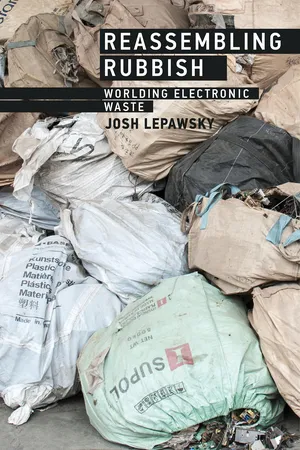
The prevailing storyline about the problem of electronic waste frames e-waste as generated by consumers in developed countries and dumped on people and places in developing countries. In Reassembling Rubbish, Josh Lepawsky offers a different view. In an innovative analysis of the global trade and traffic in discarded electronics, Lepawsky reframes the question of the "right" thing to do with e-waste, mapping the complex flows of electronic materials. He counters the assumption that e-waste is a post-consumer problem, pointing out that waste occurs at all stages of electronic materials' existence, and calls attention to the under-researched world of reuse and repair.
Lepawsky explains that there are conflicting legal distinctions between electronic waste and non-waste, and examines a legal case that illustrates the consequences. He shows that patterns of trade do not support the dominant narrative of e-waste dumping but rather represent the dynamic ecologies of repair, refurbishment, and materials recovery. He asks how we know waste, how we measure it, and how we construe it, and how this affects our efforts to mitigate it. We might not put so much faith in household recycling if we counted the more massive amounts of pre-consumer electronic waste as official e-waste. Lepawsky charts the "minescapes," "productionscapes," and "clickscapes" of electronics, and the uneven "discardscapes" they produce. Finally, he considers both conventional and unconventional e-waste solutions, including decriminalizing export for reuse, repair, and upgrade; enabling ethical trade in electronics reuse, repair, refurbishment, and recycling; implementing extended producer responsibility; and instituting robust forms of public oversight.
- English
- ePUB (mobile friendly)
- Available on iOS & Android
eBook - ePub
About this book
Information
Table of contents
- Cover
- Title page
- Copyright page
- Dedication
- Table of Contents
- Acknowledgments
- Note on Figures
- 1 Introduction
- 2 Waste/Nonwaste
- 3 The Discard Test
- 4 Charting Flows of Electronic Waste
- 5 Looking Again in a Different Way
- 6 Weighty Geographies
- 7 Conclusion
- References
- Index
Trusted by 375,005 students
Access to over 1.5 million titles for a fair monthly price.
Study more efficiently using our study tools.
Frequently asked questions
Yes, you can cancel anytime from the Subscription tab in your account settings on the Perlego website. Your subscription will stay active until the end of your current billing period. Learn how to cancel your subscription
No, books cannot be downloaded as external files, such as PDFs, for use outside of Perlego. However, you can download books within the Perlego app for offline reading on mobile or tablet. Learn how to download books offline
Perlego offers two plans: Essential and Complete
- Essential is ideal for learners and professionals who enjoy exploring a wide range of subjects. Access the Essential Library with 800,000+ trusted titles and best-sellers across business, personal growth, and the humanities. Includes unlimited reading time and Standard Read Aloud voice.
- Complete: Perfect for advanced learners and researchers needing full, unrestricted access. Unlock 1.5M+ books across hundreds of subjects, including academic and specialized titles. The Complete Plan also includes advanced features like Premium Read Aloud and Research Assistant.
We are an online textbook subscription service, where you can get access to an entire online library for less than the price of a single book per month. With over 1.5 million books across 990+ topics, we’ve got you covered! Learn about our mission
Look out for the read-aloud symbol on your next book to see if you can listen to it. The read-aloud tool reads text aloud for you, highlighting the text as it is being read. You can pause it, speed it up and slow it down. Learn more about Read Aloud
Yes! You can use the Perlego app on both iOS and Android devices to read anytime, anywhere — even offline. Perfect for commutes or when you’re on the go.
Please note we cannot support devices running on iOS 13 and Android 7 or earlier. Learn more about using the app
Please note we cannot support devices running on iOS 13 and Android 7 or earlier. Learn more about using the app
Yes, you can access Reassembling Rubbish by Josh Lepawsky in PDF and/or ePUB format, as well as other popular books in Politics & International Relations & Environment & Energy Policy. We have over 1.5 million books available in our catalogue for you to explore.