In the early twentieth century, international oil corporations emerged as a new kind of political actor. The development of the world oil industry, argues Katayoun Shafiee, was one of the era's largest political projects of techno-economic development. In this book, Shafiee maps the machinery of oil operations in the Anglo-Iranian oil industry between 1901 and 1954, tracking the organizational work involved in moving oil through a variety of technical, legal, scientific, and administrative networks. She shows that, in a series of disagreements, the British-controlled Anglo-Iranian Oil Company (AIOC, which later became BP) relied on various forms of information management to transform political disputes into techno-economic calculation, guaranteeing the company complete control over profits, labor, and production regimes. She argues that the building of alliances and connections that constituted Anglo-Iranian oil's infrastructure reconfigured local politics of oil regions and examines how these arrangements in turn shaped the emergence of both nation-state and transnational oil corporation.
Drawing on her extensive archival and field research in Iran, Shafiee investigates the surprising ways in which nature, technology, and politics came together in battles over mineral rights; standardizing petroleum expertise; formulas for calculating profits, production rates, and labor; the "Persianization" of employees; nationalism and oil nationalization; and the long-distance machinery of an international corporation. Her account shows that the politics of oil cannot be understood in isolation from its technical dimensions.
The open access edition of this book was made possible by generous funding from Knowledge Unlatched.
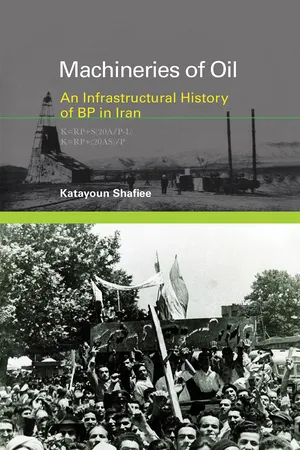
eBook - ePub
Machineries of Oil
An Infrastructural History of BP in Iran
- English
- ePUB (mobile friendly)
- Available on iOS & Android
eBook - ePub
Machineries of Oil
An Infrastructural History of BP in Iran
About this book
Information
Subtopic
Middle Eastern HistoryTable of contents
- Cover
- Series page
- Title page
- Copyright page
- Table of Contents
- Acknowledgments
- Note on Translation and Transliteration
- Introduction
- 1 Properties of Petroleum
- 2 Petroleum Knowledge
- 3 Calculating Technologies in Crisis
- 4 What Kind of Worker Does an Oil Industry Require to Survive?
- 5 Assembling Intractability: Managing Nationalism, Combating Nationalization
- 6 Long-Distance Machineries of Oil
- Conclusion: Petroleum Collectives—Translating the Power of Oil into Politics
- Abbreviations
- Bibliography
- Index
Trusted by 375,005 students
Access to over 1.5 million titles for a fair monthly price.
Study more efficiently using our study tools.
Frequently asked questions
Yes, you can cancel anytime from the Subscription tab in your account settings on the Perlego website. Your subscription will stay active until the end of your current billing period. Learn how to cancel your subscription
No, books cannot be downloaded as external files, such as PDFs, for use outside of Perlego. However, you can download books within the Perlego app for offline reading on mobile or tablet. Learn how to download books offline
Perlego offers two plans: Essential and Complete
- Essential is ideal for learners and professionals who enjoy exploring a wide range of subjects. Access the Essential Library with 800,000+ trusted titles and best-sellers across business, personal growth, and the humanities. Includes unlimited reading time and Standard Read Aloud voice.
- Complete: Perfect for advanced learners and researchers needing full, unrestricted access. Unlock 1.5M+ books across hundreds of subjects, including academic and specialized titles. The Complete Plan also includes advanced features like Premium Read Aloud and Research Assistant.
We are an online textbook subscription service, where you can get access to an entire online library for less than the price of a single book per month. With over 1.5 million books across 990+ topics, we’ve got you covered! Learn about our mission
Look out for the read-aloud symbol on your next book to see if you can listen to it. The read-aloud tool reads text aloud for you, highlighting the text as it is being read. You can pause it, speed it up and slow it down. Learn more about Read Aloud
Yes! You can use the Perlego app on both iOS and Android devices to read anytime, anywhere — even offline. Perfect for commutes or when you’re on the go.
Please note we cannot support devices running on iOS 13 and Android 7 or earlier. Learn more about using the app
Please note we cannot support devices running on iOS 13 and Android 7 or earlier. Learn more about using the app
Yes, you can access Machineries of Oil by Katayoun Shafiee, Janet Vertesi,Paul N. Edwards in PDF and/or ePUB format, as well as other popular books in Technology & Engineering & Middle Eastern History. We have over 1.5 million books available in our catalogue for you to explore.