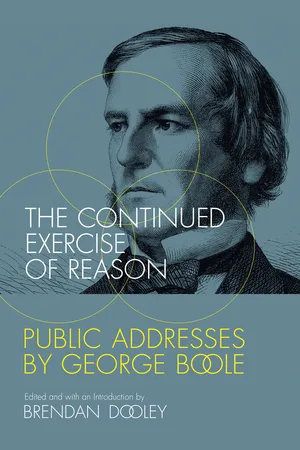
George Boole (1815–1864), remembered by history as the developer of an eponymous form of algebraic logic, can be considered a pioneer of the information age not only because of the application of Boolean logic to the design of switching circuits but also because of his contributions to the mass distribution of knowledge. In the classroom and the lecture hall, Boole interpreted recent discoveries and debates in a wide range of fields for a general audience. This collection of lectures, many never before published, offers insights into the early thinking of an innovative mathematician and intellectual polymath.
Bertrand Russell claimed that "pure mathematics was discovered by Boole," but before Boole joined a university faculty as professor of mathematics in 1849, advocacy for science and education occupied much of his time. He was deeply committed to the Victorian ideals of social improvement and cooperation, arguing that "the continued exercise of reason" joined all disciplines in a common endeavor. In these talks, Boole discusses the genius of Isaac Newton; ancient mythologies and forms of worship; the possibility of other inhabited planets in the universe; the virtues of free and open access to knowledge; the benefits of leisure; the quality of education; the origin of scientific knowledge; and the fellowship of intellectual culture. The lectures are accompanied by a substantive introduction by Brendan Dooley, the editor of the volume, that supplies biographical and historical context.
- English
- ePUB (mobile friendly)
- Available on iOS & Android
eBook - ePub
About this book
Information
Subtopic
Logic in PhilosophyIndex
HistoryTable of contents
- Cover
- Title page
- Copyright page
- Table of Contents
- Preface
- Introduction
- 1 On the Genius and Discoveries of Sir Isaac Newton
- 2 On the Character and Origin of the Ancient Mythologies
- 3 On the Question: Are the Planets Inhabited?
- 4 A Plea for Freedom
- 5 The Right Use of Leisure
- 6 On Education
- 7 The Claims of Science
- 8 The Social Aspect of Intellectual Culture
- Index
Trusted by 375,005 students
Access to over 1.5 million titles for a fair monthly price.
Study more efficiently using our study tools.
Frequently asked questions
Yes, you can cancel anytime from the Subscription tab in your account settings on the Perlego website. Your subscription will stay active until the end of your current billing period. Learn how to cancel your subscription
No, books cannot be downloaded as external files, such as PDFs, for use outside of Perlego. However, you can download books within the Perlego app for offline reading on mobile or tablet. Learn how to download books offline
Perlego offers two plans: Essential and Complete
- Essential is ideal for learners and professionals who enjoy exploring a wide range of subjects. Access the Essential Library with 800,000+ trusted titles and best-sellers across business, personal growth, and the humanities. Includes unlimited reading time and Standard Read Aloud voice.
- Complete: Perfect for advanced learners and researchers needing full, unrestricted access. Unlock 1.5M+ books across hundreds of subjects, including academic and specialized titles. The Complete Plan also includes advanced features like Premium Read Aloud and Research Assistant.
We are an online textbook subscription service, where you can get access to an entire online library for less than the price of a single book per month. With over 1.5 million books across 990+ topics, we’ve got you covered! Learn about our mission
Look out for the read-aloud symbol on your next book to see if you can listen to it. The read-aloud tool reads text aloud for you, highlighting the text as it is being read. You can pause it, speed it up and slow it down. Learn more about Read Aloud
Yes! You can use the Perlego app on both iOS and Android devices to read anytime, anywhere — even offline. Perfect for commutes or when you’re on the go.
Please note we cannot support devices running on iOS 13 and Android 7 or earlier. Learn more about using the app
Please note we cannot support devices running on iOS 13 and Android 7 or earlier. Learn more about using the app
Yes, you can access The Continued Exercise of Reason by Brendan Dooley in PDF and/or ePUB format, as well as other popular books in History & Logic in Philosophy. We have over 1.5 million books available in our catalogue for you to explore.