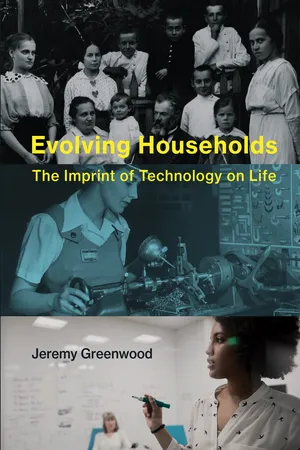
In Evolving Households, Jeremy Greenwood argues that technological progress has had as significant an effect on households as it had on industry. Taking a macroeconomic perspective, Greenwood develops simple economic models to study such phenomena as the rise in married female labor force participation, changes in fertility rates, the decline in marriage, and increased longevity. These trends represent a dramatic transformation in everyday life, and they were made possible by advancements in technology. Greenwood also addresses how technological progress can cause social change.
Greenwood shows, for example, how electricity and labor-saving appliances freed women from full-time household drudgery and enabled them to enter the labor market. He explains that fertility dropped when higher wages increased the opportunity cost of having children; he attributes the post–World War II baby boom to a combination of labor-saving household technology and advances in obstetrics and pediatrics. Marriage rates declined when single households became more economically feasible; people could be more discriminating in their choice of a mate. Technological progress also affects social and cultural norms. Innovation in contraception ushered in a sexual revolution. Labor-saving technological progress at home, together with mechanization in industry that led to an increase in the value of brain relative to brawn for jobs, fostered the advancement of women's rights in the workplace. Finally, Greenwood attributes increased longevity to advances in medical technology and rising living standards, and he examines healthcare spending, the development of new drugs, and the growing portion of life now spent in retirement.
- English
- ePUB (mobile friendly)
- Available on iOS & Android
eBook - ePub
About this book
Information
Subtopic
MacroeconomicsIndex
EconomicsTable of contents
- Cover
- Title Page
- Copyright Page
- Dedication
- Table of Contents
- Acknowledgments
- Introduction
- 1. More Working Mothers
- 2. The Baby Boom and Baby Bust
- 3. The Decline in Marriage
- 4. Social Change
- 5. Increased Longevity and Longer Retirement
- 6. Conclusion
- Mathematical Appendix
- References
- Index
Trusted by 375,005 students
Access to over 1.5 million titles for a fair monthly price.
Study more efficiently using our study tools.
Frequently asked questions
Yes, you can cancel anytime from the Subscription tab in your account settings on the Perlego website. Your subscription will stay active until the end of your current billing period. Learn how to cancel your subscription
No, books cannot be downloaded as external files, such as PDFs, for use outside of Perlego. However, you can download books within the Perlego app for offline reading on mobile or tablet. Learn how to download books offline
Perlego offers two plans: Essential and Complete
- Essential is ideal for learners and professionals who enjoy exploring a wide range of subjects. Access the Essential Library with 800,000+ trusted titles and best-sellers across business, personal growth, and the humanities. Includes unlimited reading time and Standard Read Aloud voice.
- Complete: Perfect for advanced learners and researchers needing full, unrestricted access. Unlock 1.5M+ books across hundreds of subjects, including academic and specialized titles. The Complete Plan also includes advanced features like Premium Read Aloud and Research Assistant.
We are an online textbook subscription service, where you can get access to an entire online library for less than the price of a single book per month. With over 1.5 million books across 990+ topics, we’ve got you covered! Learn about our mission
Look out for the read-aloud symbol on your next book to see if you can listen to it. The read-aloud tool reads text aloud for you, highlighting the text as it is being read. You can pause it, speed it up and slow it down. Learn more about Read Aloud
Yes! You can use the Perlego app on both iOS and Android devices to read anytime, anywhere — even offline. Perfect for commutes or when you’re on the go.
Please note we cannot support devices running on iOS 13 and Android 7 or earlier. Learn more about using the app
Please note we cannot support devices running on iOS 13 and Android 7 or earlier. Learn more about using the app
Yes, you can access Evolving Households by Jeremy Greenwood in PDF and/or ePUB format, as well as other popular books in Economics & Macroeconomics. We have over 1.5 million books available in our catalogue for you to explore.