Computational thinking—a set of mental and cognitive tools applied to problem solving—is a fundamental skill that all of us (and not just computer scientists) draw on. Educators have found that computational thinking enhances learning across a range of subjects and reinforces students' abilities in reading, writing, and arithmetic. This book offers a guide for incorporating computational thinking into middle school and high school classrooms, presenting a series of activities, projects, and tasks that employ a range of pedagogical practices and cross a variety of content areas.
As students problem solve, communicate, persevere, work as a team, and learn from mistakes, they develop a concrete understanding of the abstract principles used in computer science to create code and other digital artifacts. The book guides students and teachers to integrate computer programming with visual art and geometry, generating abstract expressionist–style images; construct topological graphs that represent the relationships between characters in such literary works as Harry Potter and the Sorcerer's Stone and Romeo and Juliet; apply Newtonian physics to the creation of computer games; and locate, analyze, and present empirical data relevant to social and political issues. Finally, the book lists a variety of classroom resources, including the programming languages Scratch (free to all) and Codesters (free to teachers). An accompanying website contains the executable programs used in the book's activities.
The open access edition of this book was made possible by generous funding from Arcadia – a charitable fund of Lisbet Rausing and Peter Baldwin.
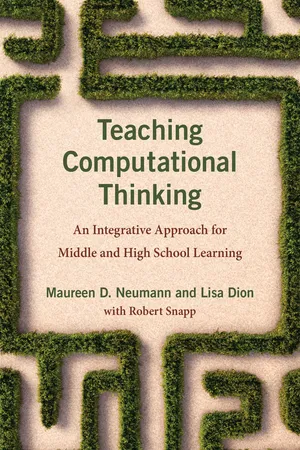
eBook - ePub
Teaching Computational Thinking
An Integrative Approach for Middle and High School Learning
- English
- ePUB (mobile friendly)
- Available on iOS & Android
eBook - ePub
Teaching Computational Thinking
An Integrative Approach for Middle and High School Learning
About this book
Information
Subtopic
Computer Science GeneralIndex
Computer ScienceTable of contents
- Cover
- Title Page
- Copyright
- Table of Contents
- Preface
- Acknowledgments
- 1. Introduction
- 2. Creating Algorithmic Art
- 3. Applying Graph Theory to Analyze Literature and Social Networks
- 4. Using Abstraction, Iteration, and Recursion in Labyrinths and Mazes
- 5. Simulating the Different Laws of Physics in Video Games
- 6. Critically Examining and Analyzing Data
- 7. Incorporating Computational Thinking into the Classroom
- Appendix: Computer Programs
- References
- Index
Trusted by 375,005 students
Access to over 1.5 million titles for a fair monthly price.
Study more efficiently using our study tools.
Frequently asked questions
Yes, you can cancel anytime from the Subscription tab in your account settings on the Perlego website. Your subscription will stay active until the end of your current billing period. Learn how to cancel your subscription
No, books cannot be downloaded as external files, such as PDFs, for use outside of Perlego. However, you can download books within the Perlego app for offline reading on mobile or tablet. Learn how to download books offline
Perlego offers two plans: Essential and Complete
- Essential is ideal for learners and professionals who enjoy exploring a wide range of subjects. Access the Essential Library with 800,000+ trusted titles and best-sellers across business, personal growth, and the humanities. Includes unlimited reading time and Standard Read Aloud voice.
- Complete: Perfect for advanced learners and researchers needing full, unrestricted access. Unlock 1.5M+ books across hundreds of subjects, including academic and specialized titles. The Complete Plan also includes advanced features like Premium Read Aloud and Research Assistant.
We are an online textbook subscription service, where you can get access to an entire online library for less than the price of a single book per month. With over 1.5 million books across 990+ topics, we’ve got you covered! Learn about our mission
Look out for the read-aloud symbol on your next book to see if you can listen to it. The read-aloud tool reads text aloud for you, highlighting the text as it is being read. You can pause it, speed it up and slow it down. Learn more about Read Aloud
Yes! You can use the Perlego app on both iOS and Android devices to read anytime, anywhere — even offline. Perfect for commutes or when you’re on the go.
Please note we cannot support devices running on iOS 13 and Android 7 or earlier. Learn more about using the app
Please note we cannot support devices running on iOS 13 and Android 7 or earlier. Learn more about using the app
Yes, you can access Teaching Computational Thinking by Maureen D. Neumann,Lisa Dion,Robert Snapp in PDF and/or ePUB format, as well as other popular books in Computer Science & Computer Science General. We have over 1.5 million books available in our catalogue for you to explore.