Hackers have a bad reputation, as shady deployers of bots and destroyers of infrastructure. In Coding Democracy, Maureen Webb offers another view. Hackers, she argues, can be vital disruptors. Hacking is becoming a practice, an ethos, and a metaphor for a new wave of activism in which ordinary citizens are inventing new forms of distributed, decentralized democracy for a digital era. Confronted with concentrations of power, mass surveillance, and authoritarianism enabled by new technology, the hacking movement is trying to "build out" democracy into cyberspace.
Webb travels to Berlin, where she visits the Chaos Communication Camp, a flagship event in the hacker world; to Silicon Valley, where she reports on the Apple-FBI case, the significance of Russian troll farms, and the hacking of tractor software by desperate farmers; to Barcelona, to meet the hacker group XNet, which has helped bring nearly 100 prominent Spanish bankers and politicians to justice for their role in the 2008 financial crisis; and to Harvard and MIT, to investigate the institutionalization of hacking. Webb describes an amazing array of hacker experiments that could dramatically change the current political economy. These ambitious hacks aim to displace such tech monoliths as Facebook and Amazon; enable worker cooperatives to kill platforms like Uber; give people control over their data; automate trust; and provide citizens a real say in governance, along with capacity to reach consensus. Coding Democracy is not just another optimistic declaration of technological utopianism; instead, it provides the tools for an urgently needed upgrade of democracy in the digital era.
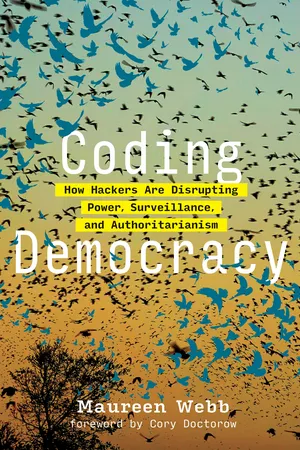
eBook - ePub
Coding Democracy
How Hackers Are Disrupting Power, Surveillance, and Authoritarianism
- English
- ePUB (mobile friendly)
- Available on iOS & Android
eBook - ePub
About this book
Information
Subtopic
Cyber SecurityTable of contents
- Cover
- Contents
- Foreword: There Are Two Kinds of People
- Author’s Note
- Acknowledgments
- 1 The Hacker Ethic: Germany’s Chaos Computer Club and the Genealogy of the Hacker Ethos
- 2 The Hacker Challenge: Cypherpunks on the Electronic Frontier
- 3 A Manifesto for the Twenty-first Century: Privacy for the Weak, Transparency for the Powerful
- 4 The Burden of Security: The Challenges for the Ordinary User
- 5 Democracy in Cyberspace: First, the Governance Problems
- 6 Culture Clash: Hermes and the Italian HackingTeam
- 7 Democracy in Cyberspace: Then the Design Problems
- 8 The Gathering Storm: The New Crypto—and Information and Net Neutrality and Free Software and Trust-Busting—Wars
- 9 Hacker Occupy: Bringing Occupy into Cyberspace and the Digital Era
- 10 Distributed Democracy: Experiments in Spain, Italy, and Canada
- 11 The Value and Risk of Transgressive Acts: Corrective Feedback
- 12 Mainstreaming Hackerdom: A New Condition of Freedom
- Coda
- Notes
- Index
Trusted by 375,005 students
Access to over 1.5 million titles for a fair monthly price.
Study more efficiently using our study tools.
Frequently asked questions
Yes, you can cancel anytime from the Subscription tab in your account settings on the Perlego website. Your subscription will stay active until the end of your current billing period. Learn how to cancel your subscription
No, books cannot be downloaded as external files, such as PDFs, for use outside of Perlego. However, you can download books within the Perlego app for offline reading on mobile or tablet. Learn how to download books offline
Perlego offers two plans: Essential and Complete
- Essential is ideal for learners and professionals who enjoy exploring a wide range of subjects. Access the Essential Library with 800,000+ trusted titles and best-sellers across business, personal growth, and the humanities. Includes unlimited reading time and Standard Read Aloud voice.
- Complete: Perfect for advanced learners and researchers needing full, unrestricted access. Unlock 1.5M+ books across hundreds of subjects, including academic and specialized titles. The Complete Plan also includes advanced features like Premium Read Aloud and Research Assistant.
We are an online textbook subscription service, where you can get access to an entire online library for less than the price of a single book per month. With over 1.5 million books across 990+ topics, we’ve got you covered! Learn about our mission
Look out for the read-aloud symbol on your next book to see if you can listen to it. The read-aloud tool reads text aloud for you, highlighting the text as it is being read. You can pause it, speed it up and slow it down. Learn more about Read Aloud
Yes! You can use the Perlego app on both iOS and Android devices to read anytime, anywhere — even offline. Perfect for commutes or when you’re on the go.
Please note we cannot support devices running on iOS 13 and Android 7 or earlier. Learn more about using the app
Please note we cannot support devices running on iOS 13 and Android 7 or earlier. Learn more about using the app
Yes, you can access Coding Democracy by Maureen Webb in PDF and/or ePUB format, as well as other popular books in Politics & International Relations & Cyber Security. We have over 1.5 million books available in our catalogue for you to explore.