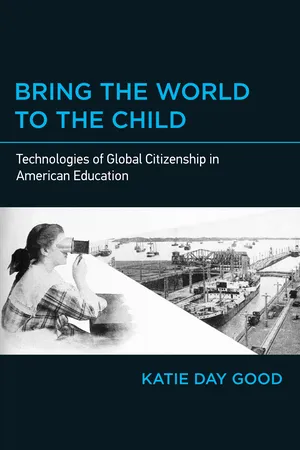
Today, educators, technology leaders, and policy makers promote the importance of "global," "wired," and "multimodal" learning; efforts to teach young people to become engaged global citizens and skilled users of media often go hand in hand. But the use of technology to bring students into closer contact with the outside world did not begin with the first computer in a classroom. In this book, Katie Day Good traces the roots of the digital era's "connected learning" and "global classrooms" to the first half of the twentieth century, when educators adopted a range of media and materials—including lantern slides, bulletin boards, radios, and film projectors—as what she terms "technologies of global citizenship."
Good describes how progressive reformers in the early twentieth century made a case for deploying diverse media technologies in the classroom to promote cosmopolitanism and civic-minded learning. To "bring the world to the child," these reformers praised not only new mechanical media—including stereoscopes, photography, and educational films—but also humbler forms of media, created by teachers and children, including scrapbooks, peace pageants, and pen pal correspondence. The goal was a "mediated cosmopolitanism," teaching children to look outward onto a fast-changing world—and inward, at their own national greatness. Good argues that the public school system became a fraught site of global media reception, production, and exchange in American life, teaching children to engage with cultural differences while reinforcing hegemonic ideas about race, citizenship, and US-world relations.
eBook - ePub
Bring the World to the Child
Technologies of Global Citizenship in American Education
- English
- ePUB (mobile friendly)
- Available on iOS & Android
eBook - ePub
About this book
Information
Topic
EducationSubtopic
Education Teaching MethodsTable of contents
- Cover
- Title Page
- Copyright Page
- Dedication
- Contents
- Acknowledgments
- 1 A Wonderland of Devices
- 2 Sightseeing in School: Promotions of Virtual Experience and World Citizenship from the Stereoscope to Radio
- 3 Coming to Our Senses: Cosmopolitan Technologies for Cosmopolitan Citizenship
- 4 Pageants of Peace: Youth Performances of Patriotism and Pluralism
- 5 Pen Pals and Messenger Dolls: The Rise of Mediated Intercultural Exchange
- 6 A “Classroom without Walls”: On the “Global Village” and Promise of Educational Technology
- Notes
- Index
Trusted by 375,005 students
Access to over 1.5 million titles for a fair monthly price.
Study more efficiently using our study tools.
Frequently asked questions
Yes, you can cancel anytime from the Subscription tab in your account settings on the Perlego website. Your subscription will stay active until the end of your current billing period. Learn how to cancel your subscription
No, books cannot be downloaded as external files, such as PDFs, for use outside of Perlego. However, you can download books within the Perlego app for offline reading on mobile or tablet. Learn how to download books offline
Perlego offers two plans: Essential and Complete
- Essential is ideal for learners and professionals who enjoy exploring a wide range of subjects. Access the Essential Library with 800,000+ trusted titles and best-sellers across business, personal growth, and the humanities. Includes unlimited reading time and Standard Read Aloud voice.
- Complete: Perfect for advanced learners and researchers needing full, unrestricted access. Unlock 1.5M+ books across hundreds of subjects, including academic and specialized titles. The Complete Plan also includes advanced features like Premium Read Aloud and Research Assistant.
We are an online textbook subscription service, where you can get access to an entire online library for less than the price of a single book per month. With over 1.5 million books across 990+ topics, we’ve got you covered! Learn about our mission
Look out for the read-aloud symbol on your next book to see if you can listen to it. The read-aloud tool reads text aloud for you, highlighting the text as it is being read. You can pause it, speed it up and slow it down. Learn more about Read Aloud
Yes! You can use the Perlego app on both iOS and Android devices to read anytime, anywhere — even offline. Perfect for commutes or when you’re on the go.
Please note we cannot support devices running on iOS 13 and Android 7 or earlier. Learn more about using the app
Please note we cannot support devices running on iOS 13 and Android 7 or earlier. Learn more about using the app
Yes, you can access Bring the World to the Child by Katie Day Good in PDF and/or ePUB format, as well as other popular books in Education & Education Teaching Methods. We have over 1.5 million books available in our catalogue for you to explore.