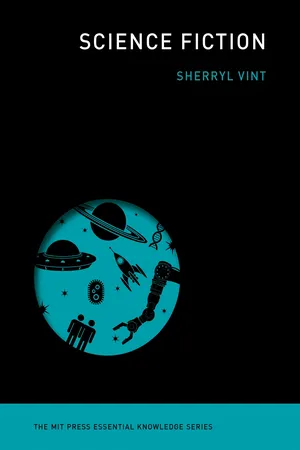
The world today seems to be slipping into a science fiction future. We have phones that speak to us, cars that drive themselves, and connected devices that communicate with each other in languages we don't understand. Depending on the news of the day, we inhabit either a technological utopia or a Brave New World nightmare. This volume in the MIT Press Essential Knowledge series surveys the uses of science fiction. It focuses on what is at the core of all definitions of science fiction: a vision of the world made otherwise and what possibilities might flow from such otherness.
After a brief overview of the genre's origins, science fiction authority Sherryl Vint considers how and why contemporary science fiction is changing. She explores anxieties in current science fiction over such key sites of technological innovation as artificial intelligence, genomic research and commodified biomedicine, and climate change. Connecting science fiction with speculative design and futurology in the corporate world, she argues that science fiction does not merely reflect these trends, but has a role in directing them.
eBook - ePub
Science Fiction
About this book
Information
Index
LiteratureTable of contents
- Cover
- Contents
- Series Foreword
- 1 Introduction: Whose Science Fiction?
- 2 The Utopian Tradition
- 3 Futurology and Speculative Design
- 4 The Colonial Imagination
- 5 Robots, AI, and Transhumanism
- 6 Genomics, the Microbiome, and Posthumanism
- 7 Environment, Climate Change, and the Anthropocene
- 8 Economics and Financialization
- 9 Conclusion: Living in a Science-Fictional World
- Acknowledgments
- Glossary
- Notes
- Further Reading
- Index
Trusted by 375,005 students
Access to over 1.5 million titles for a fair monthly price.
Study more efficiently using our study tools.
Frequently asked questions
Yes, you can cancel anytime from the Subscription tab in your account settings on the Perlego website. Your subscription will stay active until the end of your current billing period. Learn how to cancel your subscription
No, books cannot be downloaded as external files, such as PDFs, for use outside of Perlego. However, you can download books within the Perlego app for offline reading on mobile or tablet. Learn how to download books offline
Perlego offers two plans: Essential and Complete
- Essential is ideal for learners and professionals who enjoy exploring a wide range of subjects. Access the Essential Library with 800,000+ trusted titles and best-sellers across business, personal growth, and the humanities. Includes unlimited reading time and Standard Read Aloud voice.
- Complete: Perfect for advanced learners and researchers needing full, unrestricted access. Unlock 1.5M+ books across hundreds of subjects, including academic and specialized titles. The Complete Plan also includes advanced features like Premium Read Aloud and Research Assistant.
We are an online textbook subscription service, where you can get access to an entire online library for less than the price of a single book per month. With over 1.5 million books across 990+ topics, we’ve got you covered! Learn about our mission
Look out for the read-aloud symbol on your next book to see if you can listen to it. The read-aloud tool reads text aloud for you, highlighting the text as it is being read. You can pause it, speed it up and slow it down. Learn more about Read Aloud
Yes! You can use the Perlego app on both iOS and Android devices to read anytime, anywhere — even offline. Perfect for commutes or when you’re on the go.
Please note we cannot support devices running on iOS 13 and Android 7 or earlier. Learn more about using the app
Please note we cannot support devices running on iOS 13 and Android 7 or earlier. Learn more about using the app
Yes, you can access Science Fiction by Sherryl Vint in PDF and/or ePUB format, as well as other popular books in Literature & Artificial Intelligence (AI) & Semantics. We have over 1.5 million books available in our catalogue for you to explore.