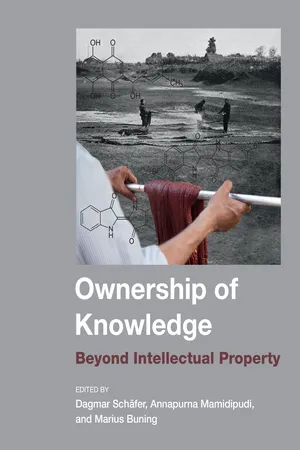
Scholars of science, technology, medicine, and law have all tended to emphasize knowledge as the sum of human understanding, and its ownership as possession by law. Breaking with traditional discourse on knowledge property as something that concerns mainly words and intellectual history, or science and law, Dagmar Schäfer, Annapurna Mamidipudi, and Marius Buning propose technology as a central heuristic for studying the many implications of knowledge ownership. Toward this end, they focus on the notions of knowledge and ownership in courtrooms, workshops, policy, and research practices, while also shedding light on scholarship itself as a powerful tool for making explicit the politics inherent in knowledge practices and social order.
The book presents case studies showing how diverse knowledge economies are created and how inequalities arise from them. Unlike scholars who have fragmented this discourse across the disciplines of anthropology, sociology, and history, the editors highlight recent developments in the emerging field of the global history of knowledge—as science, as economy, and as culture. The case studies reveal how notions of knowing and owning emerge because they reciprocally produce and determine each other's limits and possibilities; that is, how we know inevitably affects how we can own what we know; and how we own always impacts how and what we are able to know.
Contributors
Marjolijn Bol, Lissant Bolton, Cynthia Brokaw, Marius Buning, Myles W. Jackson, James Leach, Annapurna Mamidipudi, Viren Murthy, Vivek S. Oak, Jörn Oeder, Dagmar Schäfer, Amy E. Slaton
eBook - ePub
Ownership of Knowledge
Beyond Intellectual Property
- English
- ePUB (mobile friendly)
- Available on iOS & Android
eBook - ePub
Ownership of Knowledge
Beyond Intellectual Property
About this book
Information
Subtopic
Intellectual Property LawIndex
LawTable of contents
- Cover
- Series Page
- Title Page
- Copyright
- Contents
- List of Figures
- Acknowledgments
- Ownership of Knowledge: Introduction
- 1. Excavations of Knowledge Ownership: Theoretical Chapter
- I. Mutual Conditioning
- II. The Three Practices: Performance, Use, Naming
- III. The Three Domains: Society, Economy, Epistemology
- IV. The Role of Scholarship
- Contributors
- Index
- Series List
Trusted by 375,005 students
Access to over 1.5 million titles for a fair monthly price.
Study more efficiently using our study tools.
Frequently asked questions
Yes, you can cancel anytime from the Subscription tab in your account settings on the Perlego website. Your subscription will stay active until the end of your current billing period. Learn how to cancel your subscription
No, books cannot be downloaded as external files, such as PDFs, for use outside of Perlego. However, you can download books within the Perlego app for offline reading on mobile or tablet. Learn how to download books offline
Perlego offers two plans: Essential and Complete
- Essential is ideal for learners and professionals who enjoy exploring a wide range of subjects. Access the Essential Library with 800,000+ trusted titles and best-sellers across business, personal growth, and the humanities. Includes unlimited reading time and Standard Read Aloud voice.
- Complete: Perfect for advanced learners and researchers needing full, unrestricted access. Unlock 1.5M+ books across hundreds of subjects, including academic and specialized titles. The Complete Plan also includes advanced features like Premium Read Aloud and Research Assistant.
We are an online textbook subscription service, where you can get access to an entire online library for less than the price of a single book per month. With over 1.5 million books across 990+ topics, we’ve got you covered! Learn about our mission
Look out for the read-aloud symbol on your next book to see if you can listen to it. The read-aloud tool reads text aloud for you, highlighting the text as it is being read. You can pause it, speed it up and slow it down. Learn more about Read Aloud
Yes! You can use the Perlego app on both iOS and Android devices to read anytime, anywhere — even offline. Perfect for commutes or when you’re on the go.
Please note we cannot support devices running on iOS 13 and Android 7 or earlier. Learn more about using the app
Please note we cannot support devices running on iOS 13 and Android 7 or earlier. Learn more about using the app
Yes, you can access Ownership of Knowledge by Dagmar Schäfer,Annapurna Mamidipudi,Marius Buning, Edward Jones-Imhotep,Rebecca Slayton,Wiebe E. Bijker in PDF and/or ePUB format, as well as other popular books in Law & Intellectual Property Law. We have over 1.5 million books available in our catalogue for you to explore.