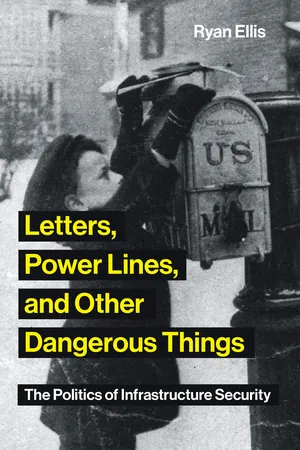
After September 11, 2001, infrastructures—the mundane systems that undergird much of modern life—were suddenly considered "soft targets" that required immediate security enhancements. Infrastructure protection quickly became the multibillion dollar core of a new and expansive homeland security mission. In this book, Ryan Ellis examines how the long shadow of post-9/11 security concerns have remade and reordered infrastructure, arguing that it has been a stunning transformation. Ellis describes the way workers, civic groups, city councils, bureaucrats, and others used the threat of terrorism as a political resource, taking the opportunity not only to address security vulnerabilities but also to reassert a degree of public control over infrastructure.
Nearly two decades after September 11, the threat of terrorism remains etched into the inner workings of infrastructures through new laws, regulations, technologies, and practices. Ellis maps these changes through an examination of three U.S. infrastructures: the postal system, the freight rail network, and the electric power grid. He describes, for example, how debates about protecting the mail from anthrax and other biological hazards spiraled into larger arguments over worker rights, the power of large-volume mailers, and the fortunes of old media in a new media world; how environmental activists leveraged post-9/11 security fears over shipments of hazardous materials to take on the rail industry and the chemical lobby; and how otherwise marginal federal regulators parlayed new mandatory cybersecurity standards for the electric power industry into a robust system of accountability.
The open access edition of this book was made possible by generous funding from Arcadia – a charitable fund of Lisbet Rausing and Peter Baldwin.
eBook - ePub
Letters, Power Lines, and Other Dangerous Things
The Politics of Infrastructure Security
- English
- ePUB (mobile friendly)
- Available on iOS & Android
eBook - ePub
Letters, Power Lines, and Other Dangerous Things
The Politics of Infrastructure Security
About this book
Information
Subtopic
InfrastructureIndex
Social SciencesTable of contents
- Cover
- Series Page
- Title Page
- Copyright
- Table of Contents
- Acknowledgments
- Introduction: Letters, Power Lines, and Other Dangerous Things
- I. The Political Origins of Infrastructure Vulnerability
- II. Ubiquitous Targets: Infrastructure Security after September 11
- Conclusion: The Politics of Critical Infrastructure Protection
- Coda: Infrastructure as Target
- Bibliography
- Index
Trusted by 375,005 students
Access to over 1.5 million titles for a fair monthly price.
Study more efficiently using our study tools.
Frequently asked questions
Yes, you can cancel anytime from the Subscription tab in your account settings on the Perlego website. Your subscription will stay active until the end of your current billing period. Learn how to cancel your subscription
No, books cannot be downloaded as external files, such as PDFs, for use outside of Perlego. However, you can download books within the Perlego app for offline reading on mobile or tablet. Learn how to download books offline
Perlego offers two plans: Essential and Complete
- Essential is ideal for learners and professionals who enjoy exploring a wide range of subjects. Access the Essential Library with 800,000+ trusted titles and best-sellers across business, personal growth, and the humanities. Includes unlimited reading time and Standard Read Aloud voice.
- Complete: Perfect for advanced learners and researchers needing full, unrestricted access. Unlock 1.5M+ books across hundreds of subjects, including academic and specialized titles. The Complete Plan also includes advanced features like Premium Read Aloud and Research Assistant.
We are an online textbook subscription service, where you can get access to an entire online library for less than the price of a single book per month. With over 1.5 million books across 990+ topics, we’ve got you covered! Learn about our mission
Look out for the read-aloud symbol on your next book to see if you can listen to it. The read-aloud tool reads text aloud for you, highlighting the text as it is being read. You can pause it, speed it up and slow it down. Learn more about Read Aloud
Yes! You can use the Perlego app on both iOS and Android devices to read anytime, anywhere — even offline. Perfect for commutes or when you’re on the go.
Please note we cannot support devices running on iOS 13 and Android 7 or earlier. Learn more about using the app
Please note we cannot support devices running on iOS 13 and Android 7 or earlier. Learn more about using the app
Yes, you can access Letters, Power Lines, and Other Dangerous Things by Ryan Ellis, Janet Vertesi,Paul N. Edwards in PDF and/or ePUB format, as well as other popular books in Social Sciences & Infrastructure. We have over 1.5 million books available in our catalogue for you to explore.