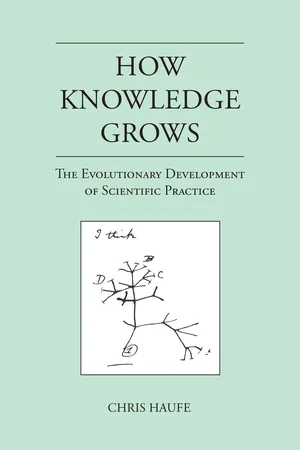
Although scientific investigation is influenced by our cognitive and moral failings as well as all of the factors impinging on human life, the historical development of scientific knowledge has trended toward an increasingly accurate picture of an increasing number of phenomena. Taking a fresh look at Thomas Kuhn's 1962 work, The Structure of Scientific Revolutions, in How Knowledge Grows Chris Haufe uses evolutionary theory to explain both why scientific practice develops the way it does and how scientific knowledge expands. This evolutionary model, claims Haufe, helps to explain what is epistemically special about scientific knowledge: its tendency to grow in both depth and breadth.
Kuhn showed how intellectual communities achieve consensus in part by discriminating against ideas that differ from their own and isolating themselves intellectually from other fields of inquiry and broader social concerns. These same characteristics, says Haufe, determine a biological population's degree of susceptibility to modification by natural selection. He argues that scientific knowledge grows, even across generations of variable groups of scientists, precisely because its development is governed by Darwinian evolution. Indeed, he supports the claim that this susceptibility to modification through natural selection helps to explain the epistemic power of certain branches of modern science. In updating and expanding the evolutionary approach to scientific knowledge, Haufe provides a model for thinking about science that acknowledges the historical contingency of scientific thought while showing why we nevertheless should trust the results of scientific research when it is the product of certain kinds of scientific communities.
- English
- ePUB (mobile friendly)
- Available on iOS & Android
eBook - ePub
About this book
Information
Topic
PhilosophySubtopic
Epistemology in PhilosophyTable of contents
- Cover
- Title Page
- Copyright
- Dedication
- Table of Contents
- Acknowledgments
- Introduction
- I. The Evolution of Scientific Knowledge
- II. The Emergence of a Discipline
- References
- Index
Trusted by 375,005 students
Access to over 1.5 million titles for a fair monthly price.
Study more efficiently using our study tools.
Frequently asked questions
Yes, you can cancel anytime from the Subscription tab in your account settings on the Perlego website. Your subscription will stay active until the end of your current billing period. Learn how to cancel your subscription
No, books cannot be downloaded as external files, such as PDFs, for use outside of Perlego. However, you can download books within the Perlego app for offline reading on mobile or tablet. Learn how to download books offline
Perlego offers two plans: Essential and Complete
- Essential is ideal for learners and professionals who enjoy exploring a wide range of subjects. Access the Essential Library with 800,000+ trusted titles and best-sellers across business, personal growth, and the humanities. Includes unlimited reading time and Standard Read Aloud voice.
- Complete: Perfect for advanced learners and researchers needing full, unrestricted access. Unlock 1.5M+ books across hundreds of subjects, including academic and specialized titles. The Complete Plan also includes advanced features like Premium Read Aloud and Research Assistant.
We are an online textbook subscription service, where you can get access to an entire online library for less than the price of a single book per month. With over 1.5 million books across 990+ topics, we’ve got you covered! Learn about our mission
Look out for the read-aloud symbol on your next book to see if you can listen to it. The read-aloud tool reads text aloud for you, highlighting the text as it is being read. You can pause it, speed it up and slow it down. Learn more about Read Aloud
Yes! You can use the Perlego app on both iOS and Android devices to read anytime, anywhere — even offline. Perfect for commutes or when you’re on the go.
Please note we cannot support devices running on iOS 13 and Android 7 or earlier. Learn more about using the app
Please note we cannot support devices running on iOS 13 and Android 7 or earlier. Learn more about using the app
Yes, you can access How Knowledge Grows by Chris Haufe in PDF and/or ePUB format, as well as other popular books in Philosophy & Epistemology in Philosophy. We have over 1.5 million books available in our catalogue for you to explore.