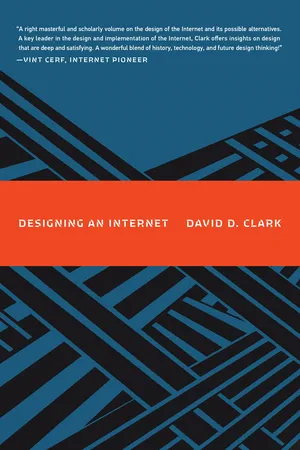
How do you design an internet? The architecture of the current Internet is the product of basic design decisions made early in its history. What would an internet look like if it were designed, today, from the ground up? In this book, MIT computer scientist David Clark explains how the Internet is actually put together, what requirements it was designed to meet, and why different design decisions would create different internets. He does not take today's Internet as a given but tries to learn from it, and from alternative proposals for what an internet might be, in order to draw some general conclusions about network architecture.
Clark discusses the history of the Internet, and how a range of potentially conflicting requirements—including longevity, security, availability, economic viability, management, and meeting the needs of society—shaped its character. He addresses both the technical aspects of the Internet and its broader social and economic contexts. He describes basic design approaches and explains, in terms accessible to nonspecialists, how networks are designed to carry out their functions. (An appendix offers a more technical discussion of network functions for readers who want the details.) He considers a range of alternative proposals for how to design an internet, examines in detail the key requirements a successful design must meet, and then imagines how to design a future internet from scratch. It's not that we should expect anyone to do this; but, perhaps, by conceiving a better future, we can push toward it.
- English
- ePUB (mobile friendly)
- Available on iOS & Android
eBook - ePub
Designing an Internet
About this book
Information
Subtopic
Computer Science GeneralIndex
Computer ScienceTable of contents
- Cover
- Series Page
- Title Page
- Copyright Page
- Dedication
- Table of Contents
- Series Editor’s Introduction
- 1. Introduction
- 2. The Basics of the Internet
- 3. Architecture and Design
- 4. Requirements
- 5. The Architecture of the Internet—A Historical Perspective
- 6. Architecture and Function
- 7. Alternative Network Architectures
- 8. Naming and Addressing
- 9. Longevity
- 10. Security
- 11. Availability
- 12. Economics
- 13. Network Management and Control
- 14. Meeting the Needs of Society
- 15. Looking to the Future
- Appendix: Addressing and Forwarding
- Acknowledgments
- Glossary
- Acronyms
- References
- Index
Trusted by 375,005 students
Access to over 1.5 million titles for a fair monthly price.
Study more efficiently using our study tools.
Frequently asked questions
Yes, you can cancel anytime from the Subscription tab in your account settings on the Perlego website. Your subscription will stay active until the end of your current billing period. Learn how to cancel your subscription
No, books cannot be downloaded as external files, such as PDFs, for use outside of Perlego. However, you can download books within the Perlego app for offline reading on mobile or tablet. Learn how to download books offline
Perlego offers two plans: Essential and Complete
- Essential is ideal for learners and professionals who enjoy exploring a wide range of subjects. Access the Essential Library with 800,000+ trusted titles and best-sellers across business, personal growth, and the humanities. Includes unlimited reading time and Standard Read Aloud voice.
- Complete: Perfect for advanced learners and researchers needing full, unrestricted access. Unlock 1.5M+ books across hundreds of subjects, including academic and specialized titles. The Complete Plan also includes advanced features like Premium Read Aloud and Research Assistant.
We are an online textbook subscription service, where you can get access to an entire online library for less than the price of a single book per month. With over 1.5 million books across 990+ topics, we’ve got you covered! Learn about our mission
Look out for the read-aloud symbol on your next book to see if you can listen to it. The read-aloud tool reads text aloud for you, highlighting the text as it is being read. You can pause it, speed it up and slow it down. Learn more about Read Aloud
Yes! You can use the Perlego app on both iOS and Android devices to read anytime, anywhere — even offline. Perfect for commutes or when you’re on the go.
Please note we cannot support devices running on iOS 13 and Android 7 or earlier. Learn more about using the app
Please note we cannot support devices running on iOS 13 and Android 7 or earlier. Learn more about using the app
Yes, you can access Designing an Internet by David D. Clark, Sandra Braman in PDF and/or ePUB format, as well as other popular books in Computer Science & Computer Science General. We have over 1.5 million books available in our catalogue for you to explore.