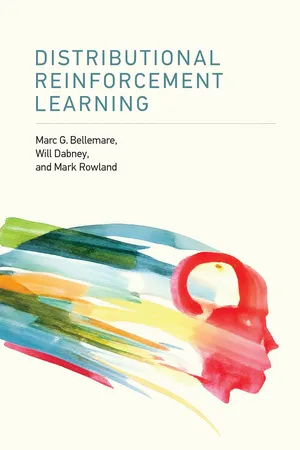
Distributional reinforcement learning is a new mathematical formalism for thinking about decisions. Going beyond the common approach to reinforcement learning and expected values, it focuses on the total reward or return obtained as a consequence of an agent's choices—specifically, how this return behaves from a probabilistic perspective. In this first comprehensive guide to distributional reinforcement learning, Marc G. Bellemare, Will Dabney, and Mark Rowland, who spearheaded development of the field, present its key concepts and review some of its many applications. They demonstrate its power to account for many complex, interesting phenomena that arise from interactions with one's environment.
The authors present core ideas from classical reinforcement learning to contextualize distributional topics and include mathematical proofs pertaining to major results discussed in the text. They guide the reader through a series of algorithmic and mathematical developments that, in turn, characterize, compute, estimate, and make decisions on the basis of the random return. Practitioners in disciplines as diverse as finance (risk management), computational neuroscience, computational psychiatry, psychology, macroeconomics, and robotics are already using distributional reinforcement learning, paving the way for its expanding applications in mathematical finance, engineering, and the life sciences. More than a mathematical approach, distributional reinforcement learning represents a new perspective on how intelligent agents make predictions and decisions.
eBook - ePub
Distributional Reinforcement Learning
- English
- ePUB (mobile friendly)
- Available on iOS & Android
eBook - ePub
Distributional Reinforcement Learning
About this book
Information
Table of contents
- Cover
- Series Page
- Title Page
- Copyright
- Contents
- Preface
- 1. Introduction
- 2. The Distribution of Returns
- 3. Learning the Return Distribution
- 4. Operators and Metrics
- 5. Distributional Dynamic Programming
- 6. Incremental Algorithms
- 7. Control
- 8. Statistical Functionals
- 9. Linear Function Approximation
- 10. Deep Reinforcement Learning
- 11. Two Applications and a Conclusion
- Notation
- References
- Index
- Series List
Trusted by 375,005 students
Access to over 1.5 million titles for a fair monthly price.
Study more efficiently using our study tools.
Frequently asked questions
Yes, you can cancel anytime from the Subscription tab in your account settings on the Perlego website. Your subscription will stay active until the end of your current billing period. Learn how to cancel your subscription
No, books cannot be downloaded as external files, such as PDFs, for use outside of Perlego. However, you can download books within the Perlego app for offline reading on mobile or tablet. Learn how to download books offline
Perlego offers two plans: Essential and Complete
- Essential is ideal for learners and professionals who enjoy exploring a wide range of subjects. Access the Essential Library with 800,000+ trusted titles and best-sellers across business, personal growth, and the humanities. Includes unlimited reading time and Standard Read Aloud voice.
- Complete: Perfect for advanced learners and researchers needing full, unrestricted access. Unlock 1.5M+ books across hundreds of subjects, including academic and specialized titles. The Complete Plan also includes advanced features like Premium Read Aloud and Research Assistant.
We are an online textbook subscription service, where you can get access to an entire online library for less than the price of a single book per month. With over 1.5 million books across 990+ topics, we’ve got you covered! Learn about our mission
Look out for the read-aloud symbol on your next book to see if you can listen to it. The read-aloud tool reads text aloud for you, highlighting the text as it is being read. You can pause it, speed it up and slow it down. Learn more about Read Aloud
Yes! You can use the Perlego app on both iOS and Android devices to read anytime, anywhere — even offline. Perfect for commutes or when you’re on the go.
Please note we cannot support devices running on iOS 13 and Android 7 or earlier. Learn more about using the app
Please note we cannot support devices running on iOS 13 and Android 7 or earlier. Learn more about using the app
Yes, you can access Distributional Reinforcement Learning by Marc G. Bellemare,Will Dabney,Mark Rowland, Francis Bach in PDF and/or ePUB format. We have over 1.5 million books available in our catalogue for you to explore.