In the last year of the nineteenth century, Max Planck constructed a theory of blackbody radiation—the radiation emitted and absorbed by nonreflective bodies in thermal equilibrium with one another—and his work ushered in the quantum revolution in physics. In this book, three physicists trace Planck's discovery. They follow the trail of Planck's thinking by constructing a textbook of sorts that summarizes the established physics on which he drew. By offering this account, the authors explore not only how Planck deployed his considerable knowledge of the physics of his era but also how Einstein and others used and interpreted Planck's work.
Planck did not set out to lay the foundation for the quantum revolution but to study a universal phenomenon for which empirical evidence had been accumulating since the late 1850s. The authors explain the nineteenth-century concepts that informed Planck's discovery, including electromagnetism, thermodynamics, and statistical mechanics. In addition, the book offers the first translations of important papers by Ludwig Boltzmann and Wilhelm Wien on which Planck's work depended.
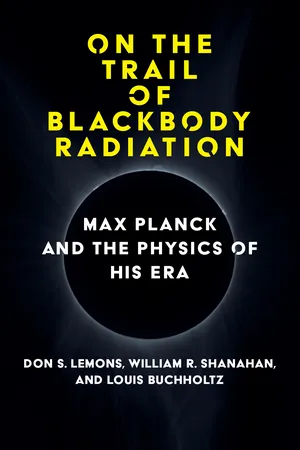
eBook - ePub
On the Trail of Blackbody Radiation
Max Planck and the Physics of his Era
- English
- ePUB (mobile friendly)
- Available on iOS & Android
eBook - ePub
On the Trail of Blackbody Radiation
Max Planck and the Physics of his Era
About this book
Information
Topic
GeschichteSubtopic
WissenschaftsgeschichteTable of contents
- Cover
- Contents
- Preface
- A Brief Guide to the Trail
- 1 The Prehistory of Blackbody Radiation
- 2 Classical Thermodynamics
- 3 Kirchhoff’s Law, 1859
- 4 The Stefan-Boltzmann Law, 1884
- 5 Wien’s Contributions, 1893–1896
- 6 The Damped, Driven, Simple Harmonic Oscillator
- 7 The Fundamental Relation
- 8 Planck’s Zeroth Derivation, 1900
- 9 Boltzmann’s Statistical Mechanics
- 10 Planck’s “First Derivation,” 1900–1901
- 11 Einstein’s Response, 1905–1907
- 12 Einstein on Emission and Absorption, 1917
- The Big Ideas
- Acknowledgments
- Annotated Bibliography
- Appendix A English Translation of “A Derivation of Stefan’s Law, Concerning the Temperature Dependence of Thermal Radiation, from the Electromagnetic Theory of Light” by Ludwig Boltzmann in Graz (1884)
- Appendix B English Translation of “A New Relationship between Blackbody Radiation and the Second Law of Thermodynamics” by Willy Wien in Charlottenburg (1893)
- Appendix C An Electromagnetic Adiabatic Invariant
- Appendix D An Ideal Gas “Displacement Law”
- Notes
- Index
Trusted by 375,005 students
Access to over 1.5 million titles for a fair monthly price.
Study more efficiently using our study tools.
Frequently asked questions
Yes, you can cancel anytime from the Subscription tab in your account settings on the Perlego website. Your subscription will stay active until the end of your current billing period. Learn how to cancel your subscription
No, books cannot be downloaded as external files, such as PDFs, for use outside of Perlego. However, you can download books within the Perlego app for offline reading on mobile or tablet. Learn how to download books offline
Perlego offers two plans: Essential and Complete
- Essential is ideal for learners and professionals who enjoy exploring a wide range of subjects. Access the Essential Library with 800,000+ trusted titles and best-sellers across business, personal growth, and the humanities. Includes unlimited reading time and Standard Read Aloud voice.
- Complete: Perfect for advanced learners and researchers needing full, unrestricted access. Unlock 1.5M+ books across hundreds of subjects, including academic and specialized titles. The Complete Plan also includes advanced features like Premium Read Aloud and Research Assistant.
We are an online textbook subscription service, where you can get access to an entire online library for less than the price of a single book per month. With over 1.5 million books across 990+ topics, we’ve got you covered! Learn about our mission
Look out for the read-aloud symbol on your next book to see if you can listen to it. The read-aloud tool reads text aloud for you, highlighting the text as it is being read. You can pause it, speed it up and slow it down. Learn more about Read Aloud
Yes! You can use the Perlego app on both iOS and Android devices to read anytime, anywhere — even offline. Perfect for commutes or when you’re on the go.
Please note we cannot support devices running on iOS 13 and Android 7 or earlier. Learn more about using the app
Please note we cannot support devices running on iOS 13 and Android 7 or earlier. Learn more about using the app
Yes, you can access On the Trail of Blackbody Radiation by Don S. Lemons,William R. Shanahan,Louis J. Buchholtz in PDF and/or ePUB format, as well as other popular books in Geschichte & Wissenschaftsgeschichte. We have over 1.5 million books available in our catalogue for you to explore.